Bells of Ireland
Bells of Ireland
Couldn't load pickup availability
Bells of Ireland Seeds — Moluccella laevis
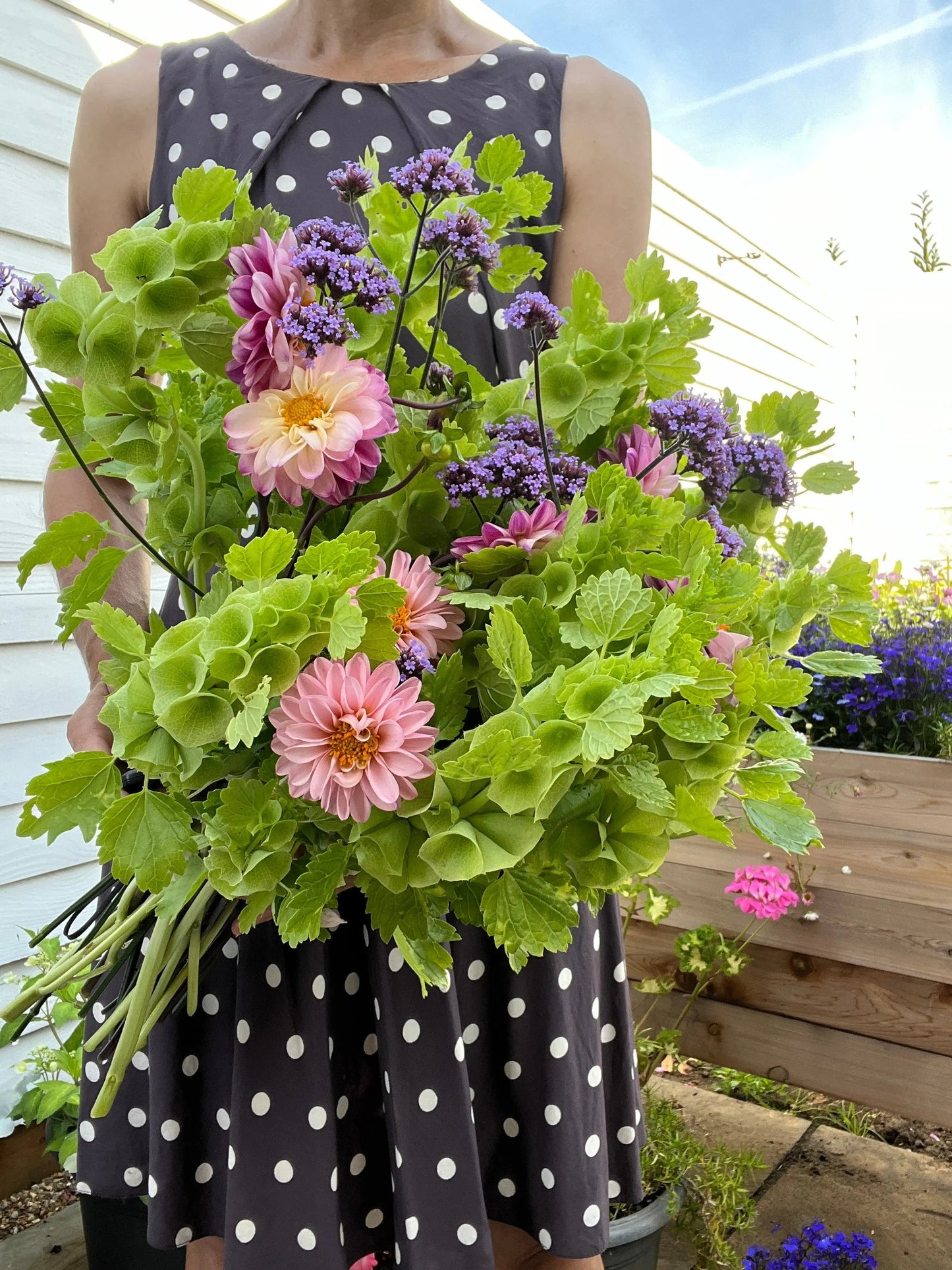
The arrangement plant that earns its place not through flower colour but through structure — tall spires of vivid apple-green bell-shaped calyces stacked along upright stems, each one housing a tiny fragrant white flower, making every other colour in a bouquet appear more vivid by providing the most architecturally interesting green available from any annual in the cutting garden.
The name is delightfully misleading. Bells of Ireland is not from Ireland, is not particularly associated with Ireland, and has no more Irish connection than its common name implies. It is a native of the eastern Mediterranean — Turkey, Syria, and the Caucasus — and was given its common name in the florist trade, most likely for the vivid emerald-green of its distinctive bell-shaped calyces and the good luck associations that colour carries in European botanical folklore. The botanical name is equally interesting: *Moluccella* suggests a connection to the Molucca Islands that is now considered unlikely and may have originated from a misidentification; *laevis* simply means smooth, which is ironic given the small sharp spines on the stems that every grower quickly learns about on first acquaintance.
What the name does not mislead about is the quality. Bells of Ireland is one of the most distinctive, most versatile, and most genuinely useful plants in the cutting garden — a green architectural element of extraordinary character that does more for the other flowers in an arrangement than any other stem it is placed alongside. Hot colours vibrate alongside it; cool colours deepen; pale colours glow. The structured, vertical, bell-stacked spire provides the architectural line that looser, rounder flowers need for balance, and the colour — a vivid, slightly luminous apple-green — works with everything. It also dries beautifully to a warm straw-green that retains structural interest through winter dried arrangements and wreaths, making it one of the few cutting annuals that is equally useful fresh and preserved.
🌿 Understanding the Plant
Moluccella laevis (Bells of Ireland / Shell Flower) is a Half-Hardy Annual (H3) and holder of the RHS Award of Garden Merit — a Mediterranean native that produces tall, upright, architectural spires of vivid apple-green bell-shaped calyces from July to September. It is grown for its structural green calyx rather than its flower — the tiny white blooms inside each bell are fragrant but visually secondary to the ornamental calyx that surrounds them.
The Botanical Structure — Calyx, Not Flower: The vivid green bells that make this plant so distinctive are not petals and not bracts — they are calyces, the sepals that form the protective cup around a flower bud and normally fade into insignificance as the flower opens. In *Moluccella laevis*, the calyx is the decorative element: it enlarges dramatically as the plant matures, becoming the prominent, bell-shaped, shell-like green structure that gives the plant both its common names (Bells of Ireland from the colour; Shell Flower from the shape). The actual flowers — small, white, fragrant, two-lipped — sit inside each calyx and are interesting close up but invisible from any distance. The plant's entire ornamental identity is built on the calyx, which is unusual and botanically distinctive.
Mediterranean Origin and Cool Summer Preference: As a Mediterranean native from relatively high-altitude regions of Turkey and Syria, Bells of Ireland is adapted to cool, moderately dry conditions rather than the baking heat of a tropical summer. It thrives in the British climate in a way that tropical herbs do not — indeed, a cool, damp British summer often produces better growth than a hot one, which is the genuine advantage of this plant's origins. It dislikes extreme heat and will bolt prematurely to flower in very hot conditions before producing sufficient bell spires for cutting.
The Drying Quality: Bells of Ireland is one of the finest drying plants in the cutting garden range, with two important qualifications. First, strip the leaves before drying — the leaves dry poorly and obscure the architectural beauty of the bell spires. Second, dry in a cool, dark, well-ventilated space rather than in direct sunlight — the green pigment is light-sensitive and UV exposure bleaches it to an unattractive beige within days of hanging in a bright location. Dried in the correct conditions, the bells retain a warm straw-green that is highly attractive in winter wreaths and dried arrangements and that lasts for years.
🌱 Growing Guide
Bells of Ireland has a specific set of requirements that, once understood, make it entirely manageable — the cold stratification, the module sowing, and the patience through slow germination are the three things that distinguish experienced growers from disappointed first-timers.
Cold Stratification:
Place the sealed seed packet in the fridge for one week before sowing. This cold period mimics the winter chill that the seed experiences in its Mediterranean natural habitat and significantly improves germination rate and consistency. Without stratification, germination is slower, more erratic, and less complete. One week in the fridge is a simple and entirely reliable method — no damp bag, no vermiculite, just the sealed packet at refrigerator temperature.
How to Sow:
Sow indoors from February to April after stratification. Surface sow onto moist compost and do not cover — Bells of Ireland requires light to germinate, like many annuals in the range. Press lightly to ensure seed-to-compost contact. Sow into individual modules or small pots rather than seed trays — this plant dislikes root disturbance and transplants significantly better when grown in a container that allows the root ball to be planted intact. Germination is slow and erratic at 21–28 days — do not discard seed trays that have not germinated within two weeks. Maintain a temperature of 15–18°C; unlike many tender annuals, Bells of Ireland does not need high warmth to germinate and may actually germinate better at the lower end of this range.
Planting Out:
Plant out from May to June after hardening off, once the risk of frost has passed. Space plants 30cm apart in a full sun position with well-drained soil. In exposed positions, install support early — the tall, heavily-belled spires are vulnerable to wind damage and stems once bent do not straighten. Horizontal netting through which plants grow is the most effective support method.
Cutting and Preparation:
Cut stems when the lower third of the bells are fully developed and the upper third are still forming. Strip all leaves before placing in water — wear gloves for this step to avoid the stem spines. Vase life is typically five to seven days; the structural quality of the bells is retained well through this period. For drying, cut at the same stage, strip leaves, and hang upside down in a cool, dark, well-ventilated space.
📋 Plant Specifications
| Botanical Name | Moluccella laevis |
| Common Names | Bells of Ireland / Shell Flower / Shellflower |
| Origin | Eastern Mediterranean (Turkey, Syria) — not Ireland |
| Plant Type | Half-Hardy Annual |
| Hardiness | H3 — tolerates light frost; plant out after last frost |
| Light Requirements | Full Sun ☀️ — tolerates light partial shade |
| Plant Height | 60–75cm — tall, upright |
| Plant Spread | 30cm |
| Plant Spacing | 30cm apart |
| Decorative Element | Green calyces (not petals) — bell-shaped, stacked along upright spires |
| Colour | Vivid apple-green fresh; warm straw-green when dried |
| Fragrance | Subtle — from the small white flowers inside each bell |
| Flowering Period | July to September |
| Drying | Excellent — strip leaves, hang in cool dark space to retain green |
| Handling Note | Small sharp spines under leaves — wear gloves when stripping |
| RHS Award of Garden Merit | Yes ✓ |
| Seeds per Packet | Approximately 200 seeds |
| Perfect For |
💐Cutting Garden Architectural Line
🍂Dried Wreaths & Winter Arrangements
🌿Bouquet Filler & Green Foliage
🏡Cottage Border Vertical Structure
✂️Professional Florist Arrangements
|
🤝 Beautiful Garden Combinations
The apple-green architectural spires of Bells of Ireland function as a neutral intensifier — they make every colour around them appear more vivid and more deliberately composed. These companions create the most beautiful and most effective pairings:
- 💜 Larkspur 'Giant Imperial Mixed': The Cottage Spire Rhythm. Two tall, vertical, spire-forming plants that flower simultaneously in July and August, one in deep blues, purples, and pinks and one in vivid green — the rhythmic alternation of the two entirely different spire forms in a border creates exactly the kind of structured, naturalistic, cottage garden planting that the best summer borders achieve. The larkspur's colour range and the Moluccella's distinctive green work as complementary elements in an arrangement as in a border — blue and purple alongside apple-green is a cool, sophisticated combination that photographs beautifully and feels genuinely refined rather than merely decorative. Both prefer cool conditions over intense heat, making them natural companions in the British summer.
- 🌸 Cosmos 'Sensation Mixed': The Airy Pink Frame. The open, airy, single daisy flowers of Cosmos 'Sensation Mixed' in pink, crimson, and white alongside the dense, structured, architectural spires of Bells of Ireland creates one of the finest texture-and-form contrasts in the summer cutting garden — the cosmos providing the lightness, movement, and informal quality that the more rigidly structured Moluccella benefits from alongside it, while the Moluccella provides the vertical line and architectural interest that the cosmos's rounded, open flowers cannot deliver alone. In the border, the two together create the best kind of cottage garden combination — apparently natural, actually considered, and genuinely beautiful from across the garden as well as close up.
- 🌿 Ammi Majus: The Green and White Architecture. Bells of Ireland alongside Ammi Majus is the most purely architectural pairing in the cutting garden range — two entirely different green-and-white structural elements, the Moluccella providing tall vertical bell spires in vivid green, the Ammi providing flat horizontal white lace umbels. Both are specialists of the arrangement rather than its focal flower; both make everything around them look better; and together in a vase, without any additional colour, they produce a combination of extraordinary refinement and botanical interest that needs no colourful focal flower added to it. For a sophisticated green-and-white arrangement — a wedding arrangement, a dinner table arrangement, anything where restraint and structure are more desirable than colour abundance — Bells of Ireland and Ammi Majus together is the complete answer.
📅 Sowing & Flowering Calendar
Refrigerate the seed for one week before sowing — Bells of Ireland requires cold stratification for reliable germination. Sow into individual modules from February, expect slow emergence at 21–28 days, and reward your patience with architectural green spires from July to September that are as valuable fresh as they are dried.
| Jan | Feb | Mar | Apr | May | Jun | Jul | Aug | Sep | Oct | Nov | Dec | |
|---|---|---|---|---|---|---|---|---|---|---|---|---|
| 🌱 Sow Indoors | ||||||||||||
| 🪴 Plant Out | ||||||||||||
| 🍏 Flowering |
Three things make the most of Bells of Ireland. First, refrigerate the sealed seed packet for one week before sowing — this is the single most important step for reliable germination, more important than sowing temperature or timing. Without it, expect slow, erratic, incomplete germination; with it, germination is still slow (21–28 days) but substantially more reliable and uniform. Second, sow into individual modules or small pots rather than a communal seed tray — Bells of Ireland dislikes root disturbance significantly enough to produce noticeably weaker plants when transplanted from a tray that disturbs the root system. A module or small pot allows the root ball to be planted intact without any disturbance at all. Third, and most importantly for anyone growing for dried arrangements: dry the stripped stems in a cool, dark, well-ventilated space. The apple-green pigment is chlorophyll-based and breaks down rapidly under UV light — stems hung in a bright room or in sunlight will be beige within a week. Stems dried in a dark space retain a warm straw-green that is genuinely attractive and that lasts for years in a winter wreath or dried arrangement.
🏆 RHS Award of Garden Merit
Moluccella laevis — not Irish, not a flower, and not easy to germinate without the fridge — is nevertheless one of the most valuable and most versatile plants in the cutting garden range: the architectural green element that makes every other stem in the vase look more intentional, more vivid, and more professionally composed. Refrigerate the seed, sow into modules, support the stems, wear gloves when stripping, and dry in the dark. The reward is apple-green spires of extraordinary structural beauty from July to September, and straw-green winter decorations of lasting quality from October onwards.
📖 Want more detailed growing advice?
View our Complete Growing Guide →
Share