Alfalfa
Alfalfa
Couldn't load pickup availability
Alfalfa Microgreens Seeds
Fresh, crunchy, and extraordinarily nutritious — a year-round windowsill harvest ready in just five to seven days. The easiest, fastest, and most nutritionally dense crop you can grow indoors, in any season, with nothing more than a jar and a piece of muslin.
There is no faster or more satisfying crop in the entire growing year than alfalfa microgreens. From seed to harvest in five to seven days, needing no soil, no outdoor space, no equipment beyond a jar and a square of muslin, and no season — these delicate, thread-fine sprouts can be grown on a kitchen windowsill in January as easily as in July. The result is a continuous supply of fresh, crunchy, mildly nutty shoots that are among the most nutritionally concentrated foods available from any growing method, packed with vitamins, minerals, and active enzymes that diminish rapidly in any stored or transported salad leaf.
Alfalfa — Medicago sativa, the plant that livestock farmers have long called the "father of all foods" — produces microgreens of particular delicacy and refinement. The shoots are fine, pale, and tenderly crisp, with a clean, mild, slightly grassy flavour that carries none of the bitterness or sharpness of brassica sprouts. They pile beautifully into sandwiches, sit lightly over soups and noodle dishes, add texture and nutrition to smoothies, and make the finest and most nutritious garnish for a summer plate that any kitchen garden — windowsill or otherwise — can produce. Once you have a jar cycling on your kitchen counter, you will wonder how you managed without it.
🌿 Understanding the Crop
Medicago sativa, commonly known as alfalfa or lucerne, is a Hardy Perennial legume native to the Middle East and Central Asia, where it has been cultivated as a forage crop for over three thousand years. As a microgreen, it is grown in its very earliest seedling stage — harvested at just 5–7 days old, when the seed leaves (cotyledons) have fully opened but before the first true leaves develop. At this stage the plant is at its nutritional peak, concentrating the full spectrum of nutrients stored in the seed into a tiny, living shoot.
Why Microgreens Are Nutritionally Extraordinary: Research consistently shows that microgreens contain significantly higher concentrations of vitamins, minerals, and antioxidants than the same plant harvested at full maturity. Alfalfa microgreens in particular are exceptionally rich in vitamins C, K, and B-complex, along with calcium, magnesium, iron, and a broad spectrum of plant enzymes that support digestion. These concentrated nutrients are present because the seedling is drawing on everything stored in the seed to fuel its initial growth — harvesting at this moment captures them at their highest density before they are diluted into the growing plant over subsequent weeks.
Two Growing Methods: Alfalfa microgreens can be grown by two distinct methods — in a shallow tray of compost or vermiculite, or by sprouting in a jar with rinsing. Both produce excellent results; the choice depends on available space, preference, and intended use.
🌱 Tray Method
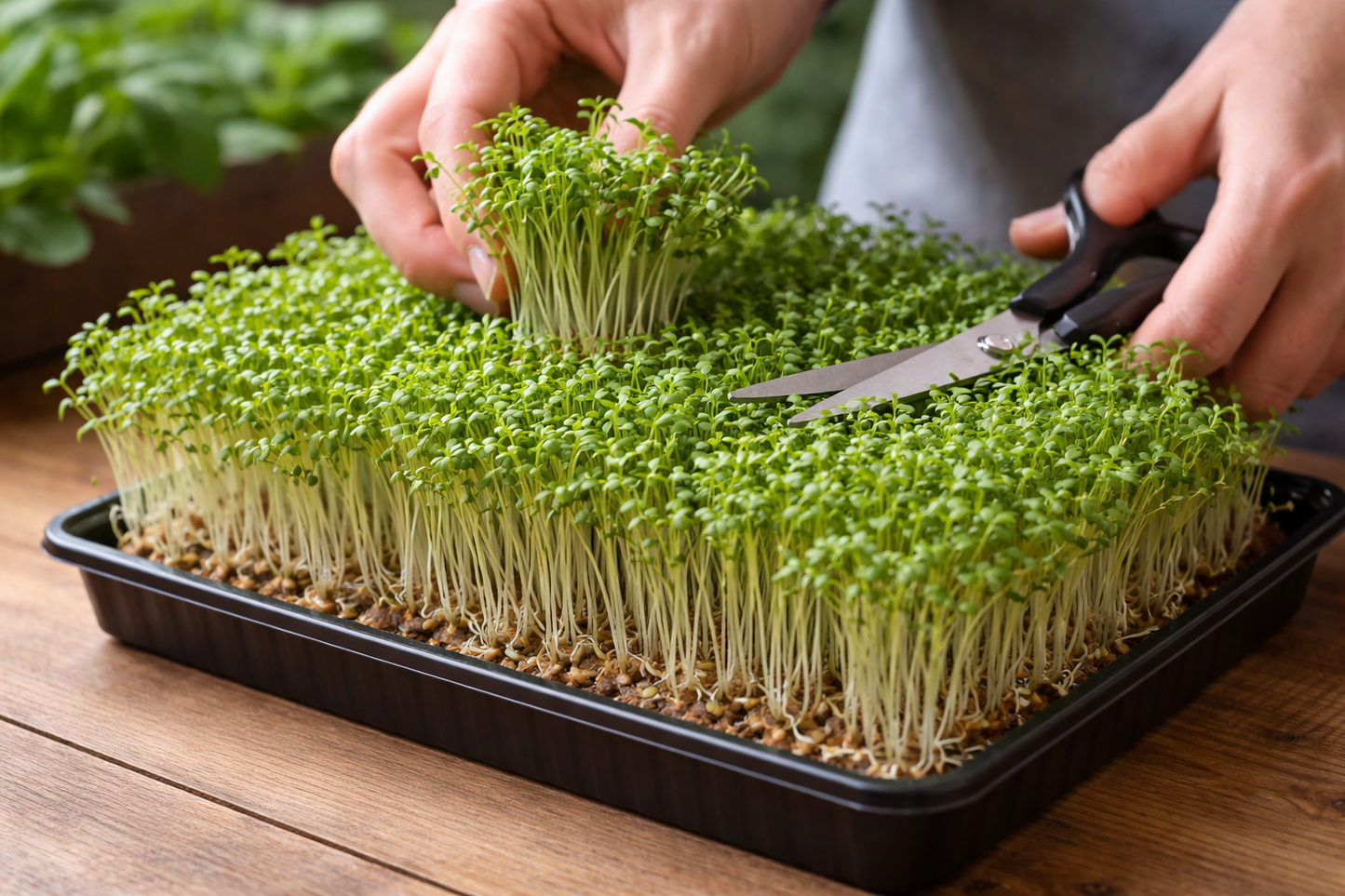
Sow seeds thinly on the surface of moist seed compost or vermiculite in a shallow tray. Cover with a second tray for the first 2–3 days to exclude light and encourage germination, then uncover and place on a bright windowsill. Harvest with scissors at soil level in 6–8 days. Produces longer, more uniform shoots with a slightly more developed flavour.
🫙 Jar Method
Soak seeds overnight, drain, and place in a jar covered with muslin secured with a rubber band. Rinse and drain twice daily, keeping the jar tilted to allow drainage and air circulation. Harvest in 5–7 days when the seed leaves have opened. Requires no compost, no equipment beyond a jar, and is the simplest possible way to begin growing microgreens.
Year-Round Growing: Unlike any outdoor crop, alfalfa microgreens can be grown every month of the year on a warm, bright kitchen windowsill. A minimum temperature of 18–22°C produces the fastest and most vigorous germination — a warm kitchen in winter is actually an ideal growing environment. With a new batch started every five to seven days, a single jar or tray provides a completely unbroken supply of fresh microgreens throughout the year.
🌱 Growing Guide
Alfalfa microgreens are the most beginner-friendly crop in the entire growing world — no soil preparation, no outdoor space, no special equipment, and results in less than a week.
Jar Method — Step by Step:
Day 0 (Evening): Place 1–2 tablespoons of alfalfa seeds in a clean jar. Cover with cool water and leave to soak overnight — 8 to 12 hours.
Day 1 (Morning): Drain the soaking water thoroughly. Cover the jar mouth with a piece of fine muslin, cheesecloth, or a dedicated sprouting lid secured with a rubber band. Tilt the jar upside down at a 45-degree angle in a bowl or dish rack to allow any remaining water to drain away and air to circulate freely. Keep in a warm, dark or dimly lit spot for the first two days.
Days 2–6: Rinse by filling the jar with fresh cool water, swirling gently, and draining completely — morning and evening, twice daily without fail. Return to the angled position after each rinse. From Day 3 onwards, move to a bright windowsill to green up the shoots.
Day 5–7: Harvest when the seed leaves are fully open, bright green, and 3–5cm long. Rinse one final time, drain thoroughly, and use immediately or store loosely in the fridge for up to three days.
Tray Method — Step by Step:
Fill a shallow tray (5–7cm deep) with moist seed compost or vermiculite. Scatter seeds generously across the surface — more densely than for outdoor crops — and press gently into contact with the compost. Mist with water, cover with a second tray or sheet of cardboard to exclude light, and keep at 18–22°C. Once shoots are 2–3cm tall (Day 2–3), remove the cover and place on a bright windowsill. Mist twice daily to keep the surface evenly moist. Harvest with scissors at soil level from Day 6–8 when the seed leaves have fully opened and greened up.
Hygiene:
Rinse seeds thoroughly before soaking. Use clean jars and fresh water for every batch. Ensure complete drainage after every rinse — standing water causes mould. If any batch develops an off smell or visible mould, discard immediately, clean the equipment thoroughly, and begin again with fresh seeds.
📋 Crop Specifications
| Botanical Name | Medicago sativa |
| Common Name | Alfalfa / Lucerne |
| Crop Type | Microgreen / Sprouting Seed |
| Growing Method | Jar sprouting or shallow tray — no outdoor growing required |
| Space Required | A warm windowsill — no garden needed |
| Days to Harvest | 5–7 days (jar method); 6–8 days (tray method) |
| Harvest Period | Year-round — every month of the year, indoors |
| Harvest Size | 3–5cm shoots; harvest when seed leaves are fully open and green |
| Flavour Profile | Clean, mild, slightly nutty and grassy — one of the gentlest microgreens |
| Seed Quantity per Batch | 1–2 tablespoons per standard jar; 3–4 tablespoons per 20cm tray |
| Seeds per Packet | Approximately [TBC] seeds |
| Perfect For |
🫙Year-Round Windowsill Growing
🥗Salads, Sandwiches & Wraps
💊Nutritional Density & Wellness
⚡5–7 Day Seed-to-Harvest Cycle
🏠No Garden or Outdoor Space Needed
|
Nutritional Highlights:
🍽️ Using Your Microgreens
Alfalfa microgreens are one of the most versatile and kitchen-friendly microgreens available — their mild, clean flavour means they work with almost everything rather than competing with it, and their delicate texture adds a light, fresh note to any dish.
Raw — Where They Shine:
Alfalfa microgreens are at their finest eaten raw, as soon as possible after harvesting. Pile generously into sandwiches and wraps — they add bulk, texture, and nutrition without any sharpness. Scatter over soups and noodle dishes just before serving for a cool, fresh contrast. Layer into salads alongside more robust leaves for textural interest. Use as a garnish for eggs, avocado toast, smoked salmon, or any dish that benefits from a light, fresh green note.
Light Cooking:
Unlike some sprouts, alfalfa microgreens do not suit heavy cooking — their delicate structure wilts instantly and the flavour disappears. They can however be stirred through warm dishes at the very last moment — a bowl of miso soup, a warm grain salad, or a just-scrambled egg — where residual heat softens them slightly without destroying their texture or nutrition.
Smoothies & Juices:
A small handful of alfalfa microgreens blended into a morning smoothie adds a significant nutritional boost with virtually no flavour impact — their mild taste is completely masked by fruit and is one of the easiest ways to incorporate the nutrient density of sprouts into a daily routine.
Storing:
Rinse the finished batch thoroughly in cool water, shake gently to remove excess moisture, and store loosely — not packed tightly — in a lidded container or sealed bag lined with a piece of kitchen paper in the fridge. Used within three days at their freshest, though they will keep for up to five days if stored correctly. Start a new batch on harvest day to maintain a continuous supply.
📅 Year-Round Growing Calendar
Start a new batch every five to seven days and harvest fresh microgreens every single month of the year — the only crop in the kitchen garden that is entirely independent of season, weather, or outdoor space.
| Jan | Feb | Mar | Apr | May | Jun | Jul | Aug | Sep | Oct | Nov | Dec | |
|---|---|---|---|---|---|---|---|---|---|---|---|---|
| 🌱 Sow Indoors | ||||||||||||
| ✂️ Harvest |
The secret to a continuous, uninterrupted supply of fresh alfalfa microgreens is the rolling batch system — simply start a new jar or tray every five to seven days, staggered so that as one batch is harvested, the next is just beginning to green up. Two jars running simultaneously is usually enough for a household of two, with the first jar harvested while the second is at its mid-point. Keep the system going regardless of season — a warm kitchen in December produces excellent alfalfa in exactly the same time as one in June, making this the only truly year-round fresh crop available to any home grower, regardless of whether they have a garden or not.
🏆 The World's Most Ancient Cultivated Crop
Medicago sativa has been cultivated by humans for over three thousand years — prized first as the finest fodder for horses and livestock, then recognised as one of the most nutritionally complete plants available to human nutrition. As a microgreen it delivers the concentrated essence of that nutritional heritage in five to seven days, from a jar on your kitchen counter, in every month of the year. It is the easiest, fastest, most nutritionally dense, and most season-independent crop in the entire Bishy Barnabee's range — and the one that will keep your kitchen supplied with fresh, living greens on even the coldest, darkest January morning.
📖 Want more detailed growing advice?
View our Complete Growing Guide →
Share