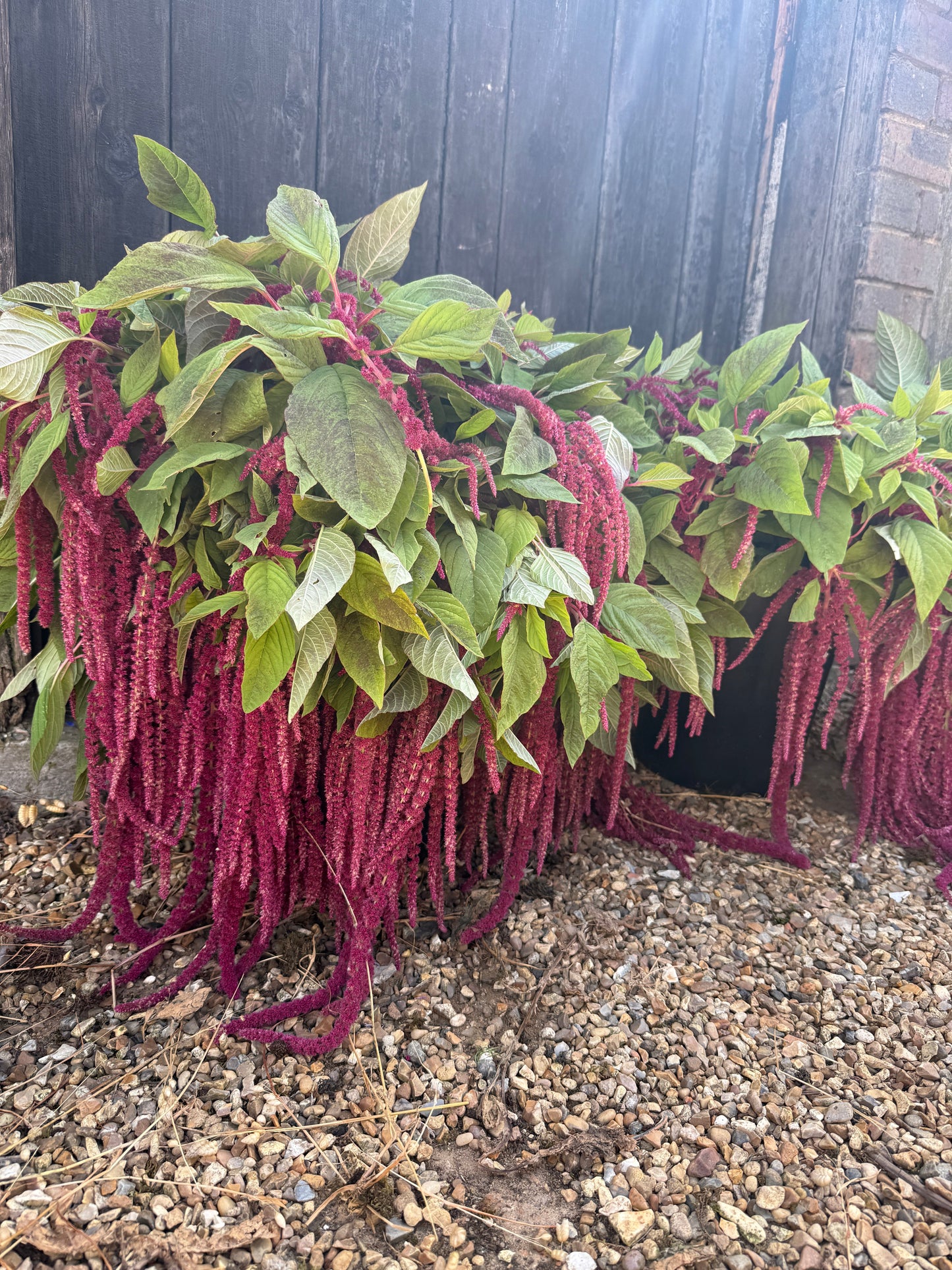
Amaranthus Red (Love-Lies-Bleeding)
Couldn't load pickup availability
Amaranthus 'Love Lies Bleeding' Seeds
Long, heavy, velvety ropes of deep burgundy-crimson that cascade from upright stems 90–120cm tall, moving in the lightest breeze with the weighted languor of theatrical velvet, and drying to hold that deep colour for years in autumn wreaths and winter arrangements.
There is no flower in the cutting garden quite like Amaranthus. Where other annuals stand upright or spread horizontally, Love Lies Bleeding falls — producing its flowers in dense, rope-like tassels that can reach 60cm in length, hanging from strong, upright stems with the heavy, swaying, darkly beautiful quality that its common name captures perfectly. The colour is a deep burgundy-crimson of almost theatrical richness — not a bright, cheerful red but a wine-dark, velvety, late-summer red that deepens and intensifies as the season progresses, and that holds through the drying process with remarkable fidelity to produce dried stems of exceptional beauty for autumn and winter arrangements.
It is also, beyond its extraordinary ornamental quality, a plant of remarkable historical depth. Long before it was grown in cottage gardens for its cascading crimson tassels, Amaranthus was a staple food crop of the Inca and Aztec civilisations of South America — the seeds ground into flour, the leaves cooked as a vegetable, the whole plant so central to the pre-Columbian agricultural economy that the Spanish colonial authorities banned its cultivation in an attempt to suppress indigenous culture. The plants survived regardless, as they tend to, and today grow in kitchen gardens across the world as both an ornamental and, for those who know it, a genuinely nutritious edible — the young leaves mild and spinach-like when cooked, the tiny seeds containing a complete amino acid profile unusual among plant foods. Love Lies Bleeding is not merely a beautiful flower. It is a plant with a history.
🌿 Understanding the Plant
Amaranthus caudatus 'Love Lies Bleeding' is a Half-Hardy Annual (H2) — a large, architectural, trailing-flowered amaranth originating from the high-altitude regions of South America (Peru, Ecuador, Bolivia), where it has been cultivated for both ornamental and nutritional purposes for several thousand years. It produces upright, bushy plants of 90–120cm in height with large, pointed-oval leaves and extraordinary pendant flower tassels of deep burgundy-crimson reaching 30–60cm in length.
The Tassel Structure: What appears to be a single flower tassel is in reality a dense, drooping inflorescence composed of thousands of tiny individual crimson flowers packed along a flexible, rope-like stem. The weight of the densely packed florets causes the inflorescence to hang vertically, creating the characteristic 'bleeding' effect. The individual florets open progressively from the base of the tassel upward over several weeks, which is why established tassels remain in good condition for such a long time — new florets continue opening at the tip while older ones at the base mature and set seed.
The Lean Soil Principle: Like many plants from challenging natural environments, amaranthus performs significantly better in lean, poor, free-draining soil than in rich, well-fed conditions. Rich soil produces rapid, lush, leafy growth at the expense of flower production — the plant invests its energy in vegetative growth when nutrients are freely available. In lean soil, with adequate light and warmth, the plant flowers abundantly, producing its tassels earlier, more numerously, and more richly coloured than it would in a well-manured border. This is counterintuitive for gardeners accustomed to feeding everything, but the evidence in the garden is unmistakable: unfed amaranthus in average soil consistently outperforms fed amaranthus in rich soil for tassel production and colour.
The Edible Dimension: The young leaves of amaranthus are edible when cooked — mild, tender, and nutritious, used in the same way as spinach or chard. The seeds, which ripen in quantity by late summer and autumn, can be harvested and used as a grain — with a complete amino acid profile unusual among plant-based foods, they are genuinely nutritious as well as interesting. For the kitchen gardener who grows Love Lies Bleeding primarily as an ornamental, the edible quality adds an unexpected and genuinely useful dimension to a plant of already exceptional garden value.
The Name: The common name Love Lies Bleeding has been attached to this plant since at least the seventeenth century and is believed to reference either the cascading crimson tassels themselves — resembling drops of blood — or the plant's association in the Victorian language of flowers with hopeless or unrequited love. Either explanation suits the plant's particular quality of melancholy beauty, and the name has endured through centuries of garden writing precisely because it is so exactly right.
🌱 Growing Guide
Amaranthus has two critical requirements — warmth to germinate and full sun to thrive — but is otherwise one of the most self-sufficient and least demanding annuals in the cutting garden once these conditions are met.
How to Sow:
Sow indoors from March to May in modules or small pots. The seeds are tiny — dark specks that need both warmth and light to germinate. Press lightly onto the surface of moist compost and do not cover, or apply only the most minimal possible dusting of vermiculite. Maintain a temperature of 18–21°C — a heated propagator or warm windowsill is ideal. Germination typically occurs within 10–14 days. Once seedlings develop their first true leaves, pot on into larger individual pots and grow on in a warm, bright position.
Planting Out:
Plant out from late May to June only after all risk of frost has completely passed — amaranthus is sensitive to cold when young and will sulk, stall, or die in cold conditions that a more robust annual would shrug off. Harden off thoroughly over seven to ten days before planting. Space plants 45–60cm apart — they develop into large, bushy plants and need the space to achieve their full architectural presence.
Soil and Feeding:
Full sun is essential — at least six hours of direct sunlight daily, and more is better. Well-drained to poor soil is actively preferred over rich, fertilised ground. Do not feed with a nitrogen-rich fertiliser — this produces excessive leafy growth at the direct expense of tassel production. In a freshly manured border, consider growing amaranthus in a different location where the soil is more average.
Support:
In exposed positions, the tall stems of mature plants can require staking — the weight of long, heavy tassels in wind can cause stems to lean or fall. A single cane per plant inserted at planting and tied loosely as the plant grows is sufficient in most situations.
Cutting and Drying:
For fresh use, cut tassels when fully formed and the colour at its richest. For drying — where amaranthus is at its most outstanding — cut when the tassels are fully developed but before the tiny seeds begin to ripen and roughen. Strip most of the leaves, tie five or six stems in a loose bunch, and hang upside down in a warm, dark, well-ventilated space for two to three weeks. Properly dried tassels hold their deep burgundy-crimson colour for years, making them among the most durable and most beautiful dried stems available from the cutting garden.
📋 Plant Specifications
| Botanical Name | Amaranthus caudatus |
| Common Names | Love Lies Bleeding / Tassel Flower / Velvet Flower |
| Plant Type | Half-Hardy Annual |
| Hardiness | H2 — tender; plant out only after all risk of frost has passed |
| Light Requirements | Full Sun ☀️ — at least 6 hours daily; essential for tassel production |
| Plant Height | 90–120cm — tall, upright, architectural |
| Plant Spread | 45–60cm |
| Plant Spacing | 45–60cm apart |
| Tassel Length | 30–60cm — pendant, rope-like, deeply burgundy-crimson |
| Flower Colour | Deep burgundy-crimson — intensifies as the season progresses |
| Flowering Period | July to October (first frosts) |
| Soil Preference | Poor to average, free-draining — avoids rich or over-fed ground |
| Edible | Yes — young leaves cooked like spinach; seeds harvested as grain |
| Drying Quality | Outstanding — holds deep colour for years when dried correctly |
| Seeds per Packet | Approximately 150 seeds |
| Perfect For |
🎭Dramatic Architectural Focal Point
💐Fresh & Dried Cutting Garden
🍂Autumn Wreaths & Winter Arrangements
☀️Hot, Dry, Sunny Border Positions
🌿Edible & Ornamental Kitchen Garden
|
🤝 Beautiful Garden Combinations
The deep, theatrical burgundy-crimson and dramatic cascading form of Love Lies Bleeding demands companions of equal presence — these plants from the range create the most striking and most complementary combinations with its extraordinary tassels:
- 🌻 Zinnia 'Giants of California': The Bold Contrast. The upright, solid, dinner-plate blooms of Zinnia 'Giants of California' in hot coral, orange, pink, and purple alongside the cascading crimson ropes of Love Lies Bleeding is one of the most dramatically beautiful and most visually energetic combinations available from the annual cutting garden — two completely different flower forms in the same warm, rich colour family, each intensifying the other. The solid, clearly defined zinnia petals provide the horizontal visual weight that the vertically hanging tassels lack, while the flowing tassels provide the movement and drama that the upright zinnias cannot. Both are heat-lovers that flower prolifically all summer, both are outstanding cut flowers, and both look magnificent together in a large vase or as a border statement that stops visitors in their tracks.
- 💜 Verbena bonariensis: The See-Through Elegance. The tall, airy, wire-thin stems of Verbena bonariensis carrying their small purple flower clusters float around and through the more solid, substantial presence of Love Lies Bleeding with a lightness and elegance that is entirely complementary — the heavy, weighted, blood-red tassels becoming more dramatically apparent through the diaphanous purple haze of the verbena around them. The cool purple of Verbena bonariensis against the warm deep red of the amaranthus tassels is a colour combination of considerable sophistication, and both plants share the same heat tolerance, drought resilience, and outstanding butterfly value. In a late summer border this combination, with the verbena's purple clusters floating above the amaranthus's hanging crimson ropes, is one of the most beautiful and most distinctive effects available from two seed packets.
- 🌼 Rudbeckia 'Marmalade': The Warm Autumn Palette. The deep golden-orange of Rudbeckia 'Marmalade' daisy heads alongside the cascading burgundy-crimson of Love Lies Bleeding creates one of the warmest, richest, most seasonally perfect colour combinations in the late summer and autumn border — deep red and deep gold, the two most autumnal tones in any palette, brought together in flower forms of entirely contrasting character. Rudbeckia provides the classic daisy structure — horizontal, circular, strongly defined — while amaranthus provides the vertical cascade — flowing, weighted, dramatically different. In a cutting garden arrangement, stems of both together with ornamental grasses produce one of the finest and most atmospherically autumnal vase compositions available from the annual range.
- 🌸 Ammi Majus: The White Foil. The delicate white lace of Ammi Majus umbels provides the finest and most effective cooling foil for the dramatic dark warmth of Love Lies Bleeding — white and deep crimson-burgundy, lacy flatness and weighted rope, lightness and heaviness, each making the other more apparent and more beautiful by the strength of their contrast. In a large cutting garden arrangement, stems of both together create a combination of brooding, romantic, late-summer beauty that is entirely unlike anything achievable with either plant alone. The Ammi's white lace prevents the amaranthus from reading as dark and heavy; the amaranthus gives the Ammi colour, structure, and depth it cannot achieve on its own. This is the definitive cutting garden pairing for anyone wanting arrangements of genuine drama and genuine elegance simultaneously.
📅 Sowing & Flowering Calendar
Sow indoors from March under warmth and plant out after the last frost — Love Lies Bleeding establishes quickly in warm summer conditions, producing its first crimson tassels from July and continuing to develop longer, richer, more heavily cascading tassels through August, September, and October.
| Jan | Feb | Mar | Apr | May | Jun | Jul | Aug | Sep | Oct | Nov | Dec | |
|---|---|---|---|---|---|---|---|---|---|---|---|---|
| 🌱 Sow Indoors | ||||||||||||
| 🪴 Plant Out | ||||||||||||
| 🩸 Flowering |
Three things make the most of Love Lies Bleeding. First, resist feeding — this is one of the few ornamental annuals that actively performs better with no fertiliser at all in average garden soil. A nitrogen-rich feed produces dark green, leafy, lush, impressive-looking plants with disappointingly few tassels; the same plant in unfed, average, free-draining soil produces fewer leaves and dramatically more and longer tassels. The lean-soil principle is more pronounced in amaranthus than in almost any other annual in the range. Second, do not rush the planting — a warm, settled June transplant will catch up with and overtake an anxious May transplant that sat cold and sulking for two weeks before the weather improved. The plant accelerates dramatically in warmth and is genuinely fast-growing once conditions suit it. Third, harvest for drying early — cut tassels when fully formed and at peak colour, before the tiny seeds begin to roughen and ripen on the surface of the tassel. Dried at this stage, the colour is retained for years; dried later, the seeds drop and the tassel deteriorates. The best drying tassels are always cut slightly before they look fully 'finished' in the garden.
🩸 The Most Dramatic Annual in the Cutting Garden
Amaranthus caudatus 'Love Lies Bleeding' is the annual that transforms a border from a collection of pretty flowers into something with genuine theatrical presence — tall, architectural, cascading with long burgundy-crimson ropes of extraordinary beauty that dry to hold their colour for years in wreaths and arrangements. Grow it in full sun in poor soil, plant it beside Zinnia 'Giants of California' for the finest hot-colour cutting garden combination in the range, and cut it for the drier before the seeds set for dried stems of outstanding quality that will still be beautiful in the following spring. This is a plant with a name like a Victorian novel and a presence in the garden to match it.
📖 Want more detailed growing advice?
View our Complete Growing Guide →
Share