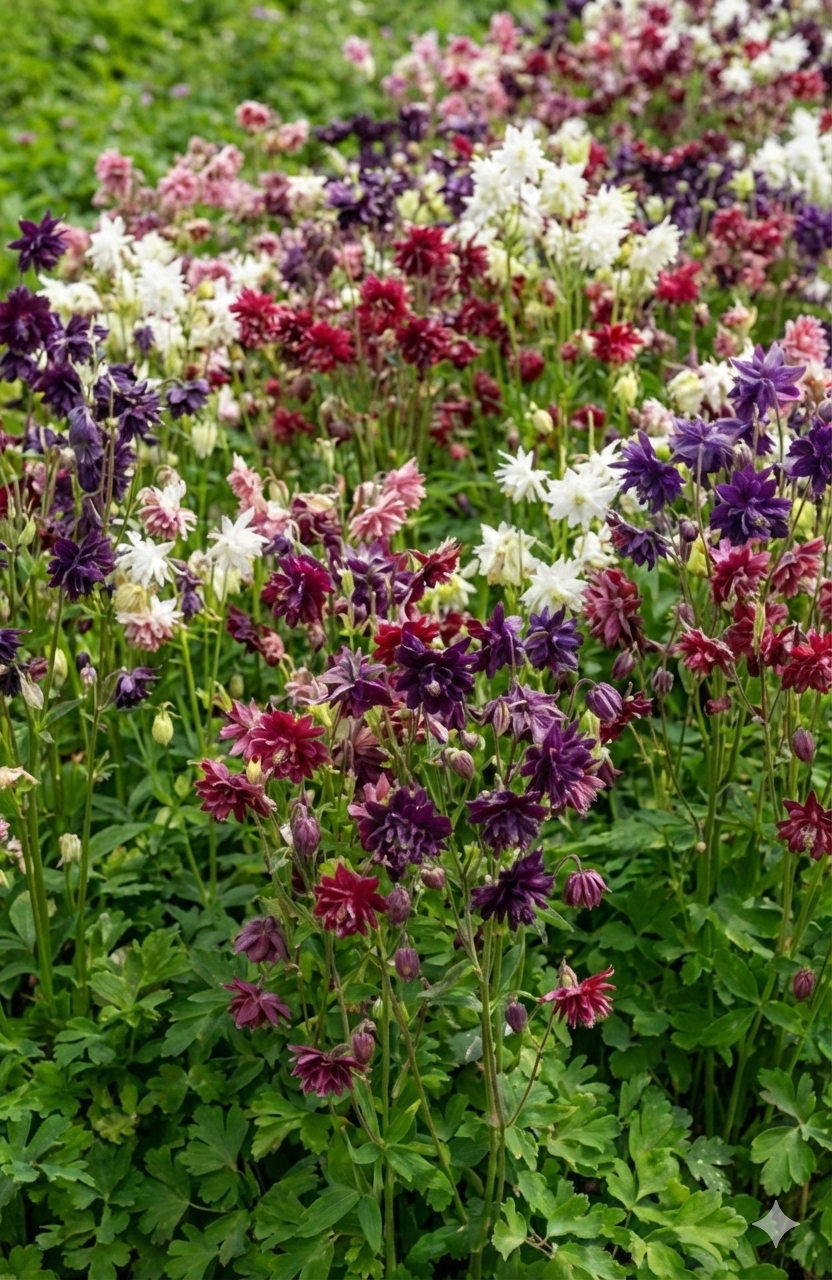
Aquilegia Barlow Mixed
Couldn't load pickup availability
Aquilegia 'Barlow Mixed' Seeds
The double columbine — fully spurless, pom-pom-flowered, and originally bred for cut flower production, producing tall stems of jewel-toned rosette blooms in deep blue, violet, pink, carmine, and white that nod in the late May breeze above lacy foliage and return faithfully by self-seeding for years after the original plants have gone.
The aquilegia — Granny's Bonnet, columbine, the flower that has appeared in more cottage garden paintings than almost any other — is already a plant of great beauty in its standard single-spurred form. The Barlow series is something further still: a fully double, spurless mutation in which the characteristic nectar spurs of the aquilegia have been replaced by additional layers of petals, producing a flower that resembles a small, frilled pompon or a miniature dahlia rather than the familiar nodding bonnet shape. The colours in 'Barlow Mixed' span the full jewel-toned aquilegia palette — deep blue-violet, wine-red, soft pink, pure white, and rich carmine, many with contrasting petal edges — and the flowers are substantially larger and more visually present than single-form aquilegias at the same height.
What makes the Barlow series historically significant is its origin — it was specifically developed for the professional cut flower trade, which is why the stems are taller (70–90cm), stronger, and more upright than many garden aquilegias, and why the vase life is considerably better than the single-form flowers that wilt within days of cutting. In the garden these qualities translate to a plant with excellent border presence — tall enough to read from a distance, strong enough not to flop in light rain, and producing flowers of sufficient individual beauty to be worth examining close up. It is also, like all aquilegias, a short-lived perennial that compensates for its three-to-four-year lifespan by self-seeding generously, creating a wandering, naturalising colony that returns year after year in new positions without any intervention from the gardener.
🌿 Understanding the Plant
Aquilegia vulgaris var. stellata 'Barlow Mixed' is a Hardy Herbaceous Perennial (H7) — the fully double, spurless form of the common European columbine, rated at the highest hardiness level in the British Isles. It holds the RHS Plants for Pollinators designation. The botanical variety name stellata refers to the star-like, flat-faced rosette of petals produced by the spurless double form, which is distinct from the standard variety and the single-spurred forms.
The Homeotic Mutation — Why the Spurs Disappeared: In a standard aquilegia flower, the five inner petals each extend backward into a long, tubular nectar spur — the characteristic shape that gives Granny's Bonnet its distinctive silhouette and that is specifically adapted for long-tongued pollinators like bumblebees and hawk-moths. In the Barlow series, a homeotic mutation has caused the genetic programme that builds these spurs to redirect into petal production instead — each spur becomes an additional petal layer, and the result is a flower of greatly increased petal density with no spurs at all. This mutation is recessive and must be maintained by careful selection — which is why the Barlow series represents a specific breeding achievement rather than simply an open-pollinated columbine.
The Cut Flower Heritage: The Barlow series was originally developed for the professional cut flower market, which explains several of its defining characteristics. The tall, upright stems — 70–90cm, significantly taller than many garden aquilegias — provide cutting stem length suitable for commercial use. The strong stem structure holds the flower heads upright rather than allowing them to nod at right angles. The larger, more densely petalled flower heads have greater visual presence in an arrangement. And the vase life, at four to seven days with proper conditioning, is considerably better than single-form aquilegias. In the garden these qualities are equally valuable, producing a plant of real structural presence that holds up well in the border.
Short-Lived Perennial — The Self-Seeding Strategy: Aquilegias are genuinely perennial but typically short-lived — three to four years per individual plant in most gardens. 'Barlow Mixed' compensates for this with prolific self-seeding that, if a few flower heads are left to set seed in late summer, produces a self-sustaining colony that wanders gently around the garden over the years. Individual plants decline and are replaced by seedlings in adjacent positions — the colony remains but its precise location shifts gradually. This wandering, naturalising quality is one of the most characteristically cottage garden attributes of aquilegia and is entirely appropriate to the way the Barlow series is best grown.
Pollinator Access Without Spurs: The loss of nectar spurs in the Barlow series removes the exclusive long-tongued pollinator access of the standard form, but the open, flat-faced rosette flowers are accessible to a wider range of short-tongued pollinators including emerging bumblebee queens — which is why the RHS Pollinators designation applies. The trade-off is a slightly different pollinator community than the single-spurred form attracts, but the accessibility to early-season bumblebees during their most critical feeding period is particularly ecologically valuable.
🌱 Growing Guide
Aquilegia requires patience — it flowers in its second year from seed — but is otherwise one of the most forgiving and most self-sufficient perennials in the range, returning year after year through self-seeding once established.
Cold Stratification — The Key to Good Germination:
Aquilegia seed has a dormancy requirement that is most reliably broken by a period of cold and moisture. The simplest method is to place seeds in a sealed bag with a small amount of damp vermiculite and refrigerate for three to four weeks before sowing in spring. Alternatively, sow in pots in January and place in an unheated cold frame or greenhouse to stratify naturally through winter, bringing indoors in March as temperatures warm. A September sowing left outdoors or in a cold frame over winter achieves the same result. Without stratification, germination is slow, erratic, and often poor — with it, germination rates improve significantly.
How to Sow:
Sow indoors from January to May after stratification, or direct sow outdoors in September for natural winter stratification. Surface sow onto moist compost — do not cover, as the seed requires light to germinate. Maintain a temperature of 15–20°C after the stratification period. Germination typically occurs within 14–35 days and can be variable even with stratification.
Transplanting:
Plant out from May to June after hardening off, once plants are large enough and the risk of frost has passed. Space plants 35cm apart in partial shade or dappled sun and humus-rich, moisture-retentive but well-drained soil. Aquilegia dislikes waterlogged conditions but thrives in the damp, humus-rich conditions of a woodland edge or shaded border.
First Year and Second Year:
In the first year after sowing, the plant establishes a basal rosette of attractive, divided, blue-green foliage but does not flower. Flowering begins in the second year, from May to June, when the tall, branching flower stems rise from the foliage rosette. This two-year cycle is a characteristic of the genus, not a growing failure.
After Flowering:
Cut the flowering stems back to the basal rosette after flowering finishes in June — fresh, attractive new foliage will emerge within weeks. For colony propagation, leave some flower heads to set seed before cutting back, and allow the seed to fall naturally around the plant. Aquilegia seedlings are easy to recognise and can be transplanted from where they have self-seeded to more desirable positions.
Cutting for the Vase:
Cut stems when the first one or two blooms on the branching spike are fully open. Condition in deep water for several hours before arranging. Vase life is four to seven days — shorter than summer annuals but entirely respectable for a spring perennial, and the flowers are sufficiently beautiful to justify it.
📋 Plant Specifications
| Botanical Name | Aquilegia vulgaris var. stellata 'Barlow Mixed' |
| Common Names | Double Columbine / Barlow Aquilegia / Granny's Bonnet |
| Plant Type | Hardy Herbaceous Perennial |
| Hardiness | H7 — ultra-hardy to below -20°C |
| Light Requirements | Partial Shade / Dappled Sun ⛅ — thrives where many annuals struggle |
| Plant Height | 70–90cm in flower — tall, upright, bred for cut flower stems |
| Plant Spread | 40–50cm |
| Plant Spacing | 35cm apart |
| Flower Form | Fully double, spurless rosette — pom-pom/miniature dahlia appearance |
| Flower Colours | Deep blue, violet, pink, raspberry, carmine, white — many bicoloured |
| Flowering Period | May to June (Year 2 from seed) |
| Lifespan | 3–4 years per plant; self-seeds to create permanent colony |
| Stratification | Recommended — 3–4 weeks cold in fridge, or natural winter cold frame |
| Vase Life | 4–7 days — cut at first one or two blooms open |
| RHS Pollinator Friendly | Yes ✓ — accessible to emerging bumblebee queens |
| Seeds per Packet | Approximately 100 seeds |
| Perfect For |
🌳Shaded Borders & Woodland Edges
✂️Spring Cut Flower Garden
🐝Early Pollinator Support
🌿Self-Seeding Naturalising Colony
🏡Classic Cottage Garden Planting
|
🤝 Beautiful Garden Combinations
The tall, nodding, jewel-toned pompon flowers of 'Barlow Mixed' flower in the classic late spring cottage garden window — these companions from the range create the most beautiful and most quintessentially cottage combinations:
- 🦊 Foxglove 'Bishy Barnabee Mix': The Woodland Tower. Foxgloves and aquilegias are the defining pairing of the May–June cottage garden — both flowering simultaneously in the same dappled shade conditions, both biennial or short-lived perennials that self-seed to create permanent naturalising colonies, and both producing flowers of extraordinary delicacy and beauty that are at the heart of the English cottage garden tradition. The tall, vertical foxglove spires provide the architectural backdrop for the more relaxed, nodding, branching aquilegia stems — the two plants creating together the layered, naturalistic, apparently uncontrived effect that is the hardest thing in garden design to achieve intentionally. In a shaded border or woodland edge with foxgloves behind and aquilegias in front, this combination is the cottage garden at its most purely characteristic.
- 🌙 Honesty (Lunaria) Mixed: The Seasonal Succession. Honesty flowers in April and May — just as the aquilegias are building toward their June peak — and then transitions into its extraordinary translucent silver seed pods that last through summer and autumn. The overlapping timing creates a natural seasonal relay: Honesty's purple flowers opening and then becoming the silver pod backdrop against which the aquilegia blooms appear. The white-and-purple Honesty flowers coordinate beautifully with the blue, violet, and carmine tones of 'Barlow Mixed', and the silver pods provide a neutral, luminous background that shows the jewel-toned pom-pom flowers to their best advantage. Both are biennial or short-lived perennials that self-seed readily, and a border of both will maintain itself almost indefinitely through self-seeding alone.
- 🌿 Ammi Majus: The White Framework. The pure white lace umbels of Ammi Majus, sown in autumn for the earliest spring germination, can be timed to overlap with the aquilegia flowering window in May and June. The white lace provides the airy, see-through framework that aquilegia's jewel-toned pompon flowers benefit most from — the white creating visual space around the more dense, richly coloured double blooms in a way that prevents them from reading as heavy or crowded. In a cutting garden arrangement, aquilegia and ammi together produce one of the finest spring vase compositions — the nodding pompon flowers of the columbine alongside the flat, intricate white lace of the umbellifer, entirely different in form and entirely complementary in effect.
- 💙 Salvia 'Violet Queen': The Blue Perennial Bridge. Salvia 'Violet Queen' flowers from June onwards — just as the aquilegia display is ending — providing a natural colour continuation in the same blue-violet register that many of the Barlow varieties occupy. Growing the two together creates a seasonal relay in the blue-purple border: the aquilegia's rich jewel-toned pom-poms of deep violet and blue in May and June handing over to the Salvia's upright violet-blue spikes from June onwards. Both are hardy perennials that return year after year, both are outstanding for pollinators, and the colour continuity between the two creates a border that feels coherent across the full summer season rather than producing the gap that follows the aquilegia's short but beautiful flowering window.
📅 Sowing & Flowering Calendar
Sow indoors from January after cold stratification, or direct sow in September for natural winter stratification — 'Barlow Mixed' establishes in its first year and flowers from May to June in its second, then self-seeds to create a permanent colony that returns every year thereafter.
| Jan | Feb | Mar | Apr | May | Jun | Jul | Aug | Sep | Oct | Nov | Dec | |
|---|---|---|---|---|---|---|---|---|---|---|---|---|
| 🌱 Sow Indoors | ||||||||||||
| 🪴 Plant Out | ||||||||||||
| 💜 Flowering (Yr 2) |
Three things make the most of 'Barlow Mixed'. First, cold stratify before sowing — three to four weeks sealed in a bag of damp vermiculite in the fridge before sowing in January or February dramatically improves germination rates and consistency compared to unsupported spring sowing. The cold mimics the winter that the seed needs to experience before it will germinate reliably. Second, let some flower heads set and drop their seed naturally each summer — this is the mechanism by which the Barlow colony perpetuates itself beyond the three-to-four-year lifespan of individual plants. A bed of Barlow aquilegias that is allowed to self-seed will still be there, in some form, in ten years' time. A bed that is deadheaded completely will need resowing from scratch every few years. Third, cut the plants back to the basal rosette after flowering — the post-flowering foliage of aquilegia can become tatty and is not the plant's most attractive season. Cutting back hard in late June or July produces fresh, attractive new foliage within weeks that looks good through the rest of the summer and is much more appealing than the old flowering stems deteriorating in situ.
💜 The Double Columbine — Cottage Garden Heritage in a Jewel-Toned Mix
Aquilegia vulgaris 'Barlow Mixed' is the perennial that defines the late May cottage garden — tall, jewel-toned, fully double pom-pom flowers nodding above lacy foliage in dappled shade, alongside foxgloves and honesty, in a combination that is as old and as perfectly right as the English cottage garden itself. Stratify the seed, plant it in shade, leave some heads to self-seed, cut back after flowering, and in two years time the display will begin — then continue, through self-seeding, indefinitely.
📖 Want more detailed growing advice?
View our Complete Growing Guide →
Share