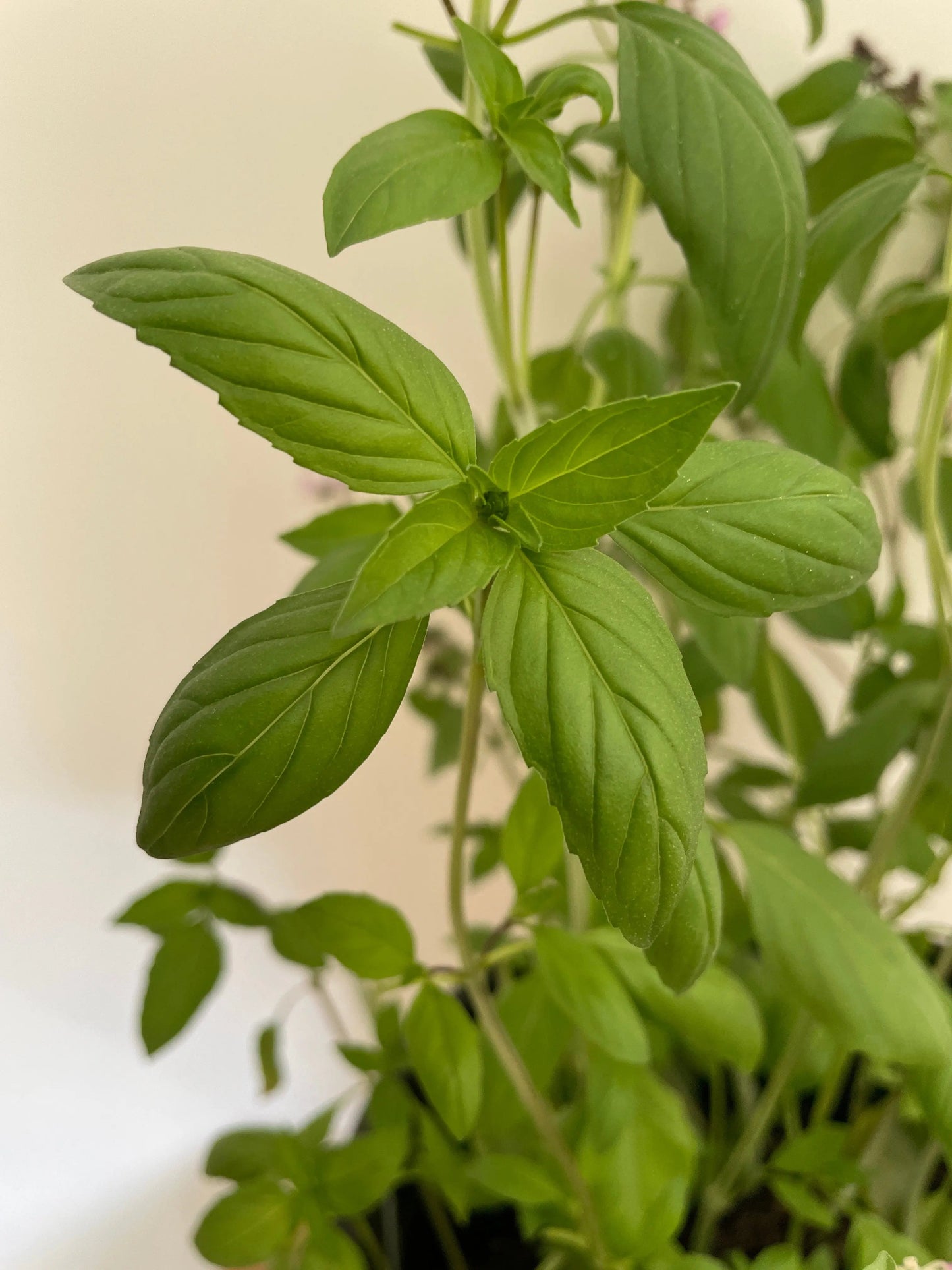
Basil Thai Large Leaf
Basil Thai Large Leaf
Couldn't load pickup availability
Ocimum basilicum var. thyrsiflora 'Horapa' Thai sweet basil — the large-leaf anise-forward variety
The authentic Thai sweet basil, and a large-leaf selection that makes it more generous and productive than the usual narrow-leaved type. Known in Thailand as Horapa, this is the basil of green curries, pho, and stir-fries — with a flavour quite distinct from its Italian cousin: assertively anise- and licorice-forward, with a gentle spiciness and a fragrance that fills the kitchen. Glossy, pointed leaves, handsome purple stems, and pink-purple flower spikes set it apart at a glance from sweet Genovese basil.
The difference from Genovese isn't just a matter of taste — it's in the flavour chemistry. Both are varieties of Ocimum basilicum, but where Genovese is dominated by linalool and methyl chavicol for that familiar sweet, lightly anise-adjacent Italian aroma, Horapa carries a higher concentration of methyl chavicol alongside cis-ocimene and other aromatic compounds — producing the bolder, more distinctly anise-forward, slightly spicy character that Thai cooking depends on. The leaves are glossier, more pointed, and a little more robust in texture, the stems flush purple, and the flower spikes come pink-purple rather than white.
Crucially for the cook, Horapa is far more heat-stable than Genovese. Where Italian basil should be added only once the heat is off, Thai basil genuinely cooks — holding its aroma through the simmering of a curry or the fierce heat of a wok. That single quality is what makes it indispensable to Southeast Asian cooking, and impossible to replace convincingly with a Mediterranean basil.
It's a tender annual in the UK, grown much like any sweet basil but, as a tropical plant, happiest with real warmth. Give it a greenhouse, conservatory, or the sunniest windowsill and it makes a compact, well-branched, aromatic plant of around 30–45cm, as ornamental on the sill as it is useful in the pan.
A note on growing
Sow indoors from March to May. As with all basils, the seed needs light to germinate, so scatter it across the surface of moist seed compost and cover with only the finest dusting of vermiculite, or nothing at all. Keep it warm at 20–25°C on a sunny windowsill or in a heated propagator, and seedlings will appear within 7–14 days.
When the seedlings have their first three sets of leaves, pinch out the growing tip to build a bushy, branching plant — and keep pinching through the season. Prick out and pot on into good compost. Being a tropical plant, Thai basil dislikes cold nights even more than the Italian sort, so keep it under cover and only move it outdoors, to the warmest sheltered sunny spot, once nights are reliably warm in summer. In most of the UK it crops best kept in the greenhouse or on a bright windowsill all season.
Water in the morning, at the base, keeping the leaves themselves dry to avoid mildew, and keep the compost evenly moist (basil is not drought-tolerant). Feed occasionally through the season. Harvest the leaves regularly from summer into autumn and pinch out most of the flower spikes to keep the plant producing — though it's well worth letting one or two spikes develop on each established plant, because the flowers are a treat in their own right (see below).
Where it shines
In the kitchen, Thai Large Leaf basil is essential to authentic Southeast Asian cooking — green and red curries, pad krapow-style stir-fries, pho and other noodle soups, and fresh salads and spring rolls. The secret to using it as the Thai do is the double-addition technique: add a generous handful early in the cooking to infuse the sauce with background flavour, then add another fresh handful in the last few seconds before serving for the bright aromatic top note. Doing only one or the other gives a good result; doing both gives the dish as it's made in Thailand.
Don't overlook the flowers, either. The pink-purple flower spikes are edible and carry a more concentrated aniseed flavour than the leaves — sweeter and more intense at once — making the finest garnish the plant produces: beautiful scattered over a green curry, a bowl of pho, or any Thai-influenced salad where a final flourish of colour and scent completes the dish. Letting one or two spikes develop per plant gives you this bonus harvest.
At a glance
- Type: Thai sweet basil (Horapa), large-leaf selection, a tender annual in the UK
- Flavour: anise- and licorice-forward with a gentle spice — bolder than Genovese
- Plant: compact, well-branched, 30–45cm, purple stems, pink-purple edible flowers
- Cooks well: heat-stable, unlike Italian basil — holds flavour in curries and stir-fries
- Sow: March to May, indoors — surface sow, needs light to germinate
- Germination: 7–14 days at 20–25°C
- Grow: greenhouse, conservatory or sunny windowsill; loves warmth
- Best for: Thai and Vietnamese curries, stir-fries, pho, and salads
Plant alongside
Thai basil shares its love of warmth and sun with chillies, peppers, and tomatoes, making it a natural greenhouse companion — and a culinary partner too, since chilli and Thai basil are inseparable on the plate. It sits happily among other warmth-loving herbs in a sunny container collection, and earns its place near fruiting crops when its pink-purple flowers open and bring in the bees.
Share