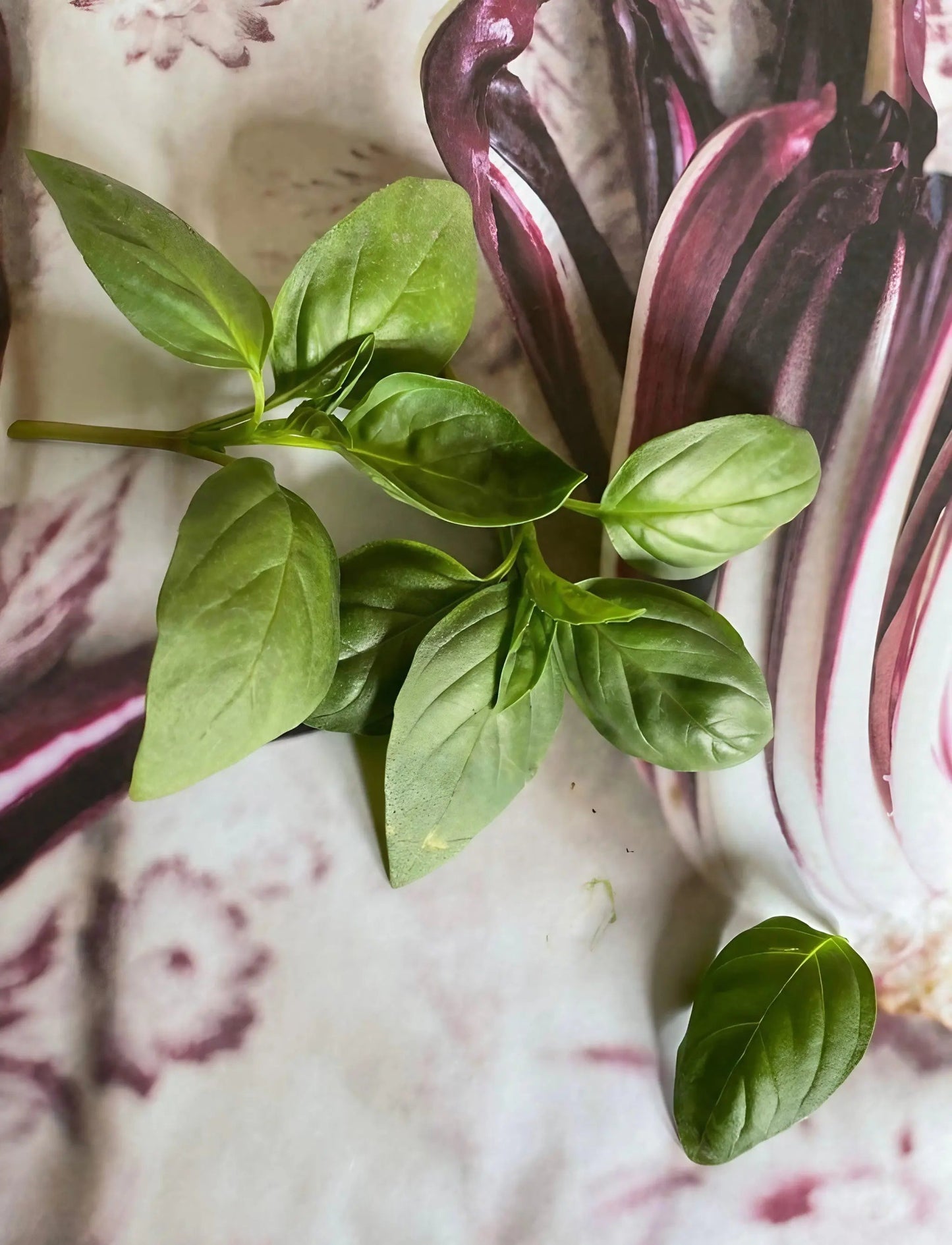
Basil Thai Siam Queen
Couldn't load pickup availability
Thai Basil 'Siam Queen' Seeds
The All-America Selections winner that earns its keep twice over — as a compact, bushy, intensely aromatic culinary Thai basil that retains full leaf flavour even when its dense deep-violet flower heads are at their most spectacular, and as one of the most ornamentally beautiful herb plants available for a pot, patio, or border edge.
Both Thai basils in the range are Horapa type — the sweet, anise-forward, heat-stable Thai basil used in curries, noodle soups, and fresh garnishing. Where 'Large Leaf' is selected specifically for the size of its individual leaves and the productivity of its cooking harvest, 'Siam Queen' is the variety selected for ornamental quality alongside culinary performance — a more compact, bushier habit, a more intensely spiced flavour profile with a distinct clove note alongside the aniseed, and enormous, dense heads of deep violet flowers that develop late in the season and turn the plant from a useful herb into something genuinely beautiful in a pot or at the front of a border.
The quality that most distinguishes 'Siam Queen' from every other basil in cultivation — and which earned it the All-America Selections award that recognises genuine advances in flavour, disease resistance, and extended performance — is that the leaves retain their flavour even when the plant is in full bloom. With most basils, flowering marks a turning point: the plant's aromatic quality diminishes, the leaves become less pleasant, and the grower must choose between the display and the harvest. 'Siam Queen' removes this choice. A plant in full flower — the deep violet heads rising above the dark-stemmed, glossy-leafed mound — is also a plant at full culinary usefulness, the leaves still harvesting with the intensity they had before the flowers opened. This is not a common trait and it is genuinely valuable.
🌿 Understanding the Plant
Ocimum basilicum var. thyrsiflora 'Siam Queen' is a Tender Annual (H1c) and All-America Selections (AAS) Winner — the compact, bushy, ornamental-flowering Horapa Thai basil in the range, recognised specifically for its superior flavour, disease resistance, and the extended flowering period that allows leaves and flowers to be harvested simultaneously without loss of leaf quality.
All-America Selections — What the Award Means: All-America Selections is North America's oldest and most respected independent non-profit plant evaluation programme, testing new varieties across a network of trial gardens before awarding recognition to those that genuinely outperform existing standards in their category. For 'Siam Queen', the AAS award recognises three specific qualities: superior anise-clove flavour intensity compared to standard Thai basil varieties, improved disease resistance (particularly against Fusarium wilt and basil downy mildew), and the specific and genuinely unusual characteristic of flavour retention through flowering. The award is well-earned and provides genuine assurance of quality beyond marketing claims.
The Flavour Retention Mechanism: In most basil varieties, the transition to flowering is associated with a shift in aromatic compound production — the plant redirects metabolic resources toward producing the compounds that attract pollinators and deter seed predators, at some cost to the leaf's culinary aromatic quality. In 'Siam Queen', this shift is significantly reduced — the metabolic balance between leaf aromatic production and flower development is maintained more evenly through the flowering period, allowing leaves harvested from a flowering plant to retain most of their pre-flowering aromatic intensity. The practical result is a plant that provides a visual display and a cooking harvest simultaneously for a period when other basil varieties require a choice between the two.
Siam Queen versus Large Leaf Thai: Both varieties are *O. basilicum* var. *thyrsiflora* Horapa, and both provide the same fundamental Thai basil culinary character — anise-forward, heat-stable, suitable for both early sauce infusion and last-second fresh addition. The practical differences: Siam Queen is more compact (30–40cm vs 40–50cm for Large Leaf), produces larger and more ornamentally impressive flower heads, retains leaf flavour through flowering, carries the AAS award, and has 100 seeds per packet. Large Leaf is taller, has larger individual leaves, has 300 seeds per packet, and is the more purely productive culinary variety. Both are valuable; Siam Queen offers more in a single pot or small space, Large Leaf offers more sheer volume of leaf harvest across a season.
🌱 Growing Guide
'Siam Queen' is grown in the same way as 'Large Leaf' Thai basil — same sowing timing, same light germination requirement, same planting-out advice, same pinching timing. The difference in practice is that 'Siam Queen' rewards being allowed to flower rather than having every flower spike removed, which changes the management approach in the second half of the season.
How to Sow:
Sow indoors from March to May. Surface sow onto moist compost with only the lightest dusting of vermiculite. Maintain a temperature of 20°C+. Germination typically occurs within 7–14 days. With 100 seeds per packet, sow carefully and prick out individual seedlings into their own pots at the first true leaf stage.
Pinching Out:
Pinch out the central growing tip at approximately 15cm to encourage a bushy, branching habit — the compact, mounded form that is one of 'Siam Queen's most attractive qualities is enhanced by good early pinching that promotes laterals from low on the stem. A well-pinched plant develops the characteristic rounded, full mound shape that makes it so effective in a pot.
Planting Out:
Plant out in June after the last frost, in a hot, sheltered, full-sun position. 'Siam Queen' is particularly well suited to container growing on a sunny patio — the compact bushy habit, the ornamental purple stems, and the spectacular flowering display are all shown to their best advantage in a pot where the whole plant can be seen from all angles. Space at 25cm in the ground, or use a 30–35cm pot for a single statement plant.
Harvesting Alongside the Display:
Because 'Siam Queen' retains its leaf flavour through flowering, the management approach is different from other basils. Rather than removing every flower spike the moment it appears, allow the plant to develop its full flower display while continuing to harvest leaves from the lower and lateral stems. The deep violet flower heads are edible — sweet and spicy, an excellent garnish — and a plant in full flower with a well-maintained leaf harvest is producing at two registers simultaneously. Only remove flower heads that have finished and begun to set seed, to prevent the plant diverting resources entirely into seed production.
📋 Plant Specifications
| Botanical Name | Ocimum basilicum var. thyrsiflora 'Siam Queen' |
| Common Names | Thai Basil 'Siam Queen' / Horapha / Sweet Thai Basil |
| Plant Type | Tender Annual |
| Hardiness | H1c — very tender; plant out June only |
| Light Requirements | Full Sun ☀️ — hot, sheltered position; ideal in pots |
| Plant Height | 30–40cm — compact, bushy, mounded habit |
| Plant Spread | 30cm |
| Plant Spacing | 25cm apart; or one plant per 30–35cm pot |
| Leaf Character | Glossy, dark-stemmed; intense aniseed-clove-liquorice flavour |
| Flavour during Flowering | Retained — unique quality; harvest leaves and flowers simultaneously |
| Flower Heads | Dense, large, deep violet — ornamentally spectacular |
| Edible Flowers | Yes — sweet and spicy, excellent garnish |
| Award | All-America Selections (AAS) Winner ✓ |
| Harvest Period | June to October |
| Seeds per Packet | Approximately 100 seeds |
| Perfect For |
💜Ornamental Herb Pot Display
🍛Thai Curries & Noodle Soups
🌸Edible Flower Garnishes
🐝Pollinator Herb Garden
🏺Hot Patio & Container Display
|
🤝 Garden & Kitchen Combinations
The deep violet flowers, dark purple stems, and glossy leaves of 'Siam Queen' make it one of the most visually striking herbs in the range — these companions create the finest ornamental and culinary partnerships:
- 🌶️ Chilli 'Basket of Fire': The Hot Pot Display. 'Basket of Fire' chilli is one of the most ornamentally beautiful compact chillies available — upright-fruiting, producing masses of small fruits that transition from cream through yellow and orange to brilliant scarlet as they ripen, creating a multi-coloured display on a compact plant that is genuinely as decorative as it is functional. Alongside 'Siam Queen' Thai basil — deep violet flower heads, dark purple stems, glossy green leaves — the two together in adjacent pots create the most visually striking hot-season container display available from the herb and vegetable range, the warm reds and oranges of the chilli fruits complementing the cool violet of the basil flowers with a colour contrast that stops visitors on a summer patio. Both love the same hot, full-sun, sheltered conditions; both provide essential ingredients for Thai and Southeast Asian cooking from a very small space.
- 🌼 Tagetes 'Burning Embers': The Pest Patrol and Colour Contrast. The warm burnt-orange and mahogany tones of Tagetes 'Burning Embers' flowers alongside the deep violet blooms and dark purple stems of 'Siam Queen' creates one of the finest colour contrasts available in a herb and companion plant combination — warm orange against cool violet, the same complementary relationship that gives the late-summer border its greatest energy. The practical benefit is equally valuable: Tagetes roots exude compounds that suppress soil nematodes, while the open flowers provide outstanding nectar for the hoverflies and parasitic wasps that keep aphid populations in check — giving the basil plants the most effective biological pest management available without any chemical intervention.
- 🌿 Thai Basil 'Large Leaf': The Complete Thai Basil Pot Garden. Growing 'Siam Queen' alongside 'Large Leaf' provides the most complete Thai basil kitchen garden available from the range — the compact, ornamental, AAS-award-winning Siam Queen offering the display and the dual harvest alongside the taller, more productive, larger-leafed variety for maximum culinary volume. The two plants look excellent together in adjacent pots or in a wide container, the Siam Queen's violet flower heads at the front or edge with the taller Large Leaf providing the backdrop — and in the kitchen, the two offer the same fundamental Horapa flavour in slightly different registers, the Siam Queen with its more pronounced clove note and its continued quality through flowering, the Large Leaf with its larger individual leaves and higher per-plant leaf volume. Both are Horapa; together they cover every Thai basil application and every preference.
- 🌿 Basil 'Classic Italian': The East-West Herb Garden. Growing 'Siam Queen' Thai basil alongside Classic Italian Genovese provides the essential basil for two entirely different cooking traditions from a pair of pots on the same sunny windowsill or patio — the sweet, Genovese Genovese for Italian dishes, pesto, and caprese, the intensely spiced, anise-clove Siam Queen for Thai curries, noodle soups, and Southeast Asian preparations. Both are tender annuals requiring the same conditions, both are productive from June to October, and both reward the same pinching and regular harvesting approach. The comparison of the two in a single herb garden — pressing a leaf of each between thumb and forefinger and breathing in the entirely different aromatic worlds they represent — is one of the more instructive small pleasures of growing herbs from seed.
📅 Sowing & Harvesting Calendar
Sow indoors from March — 'Siam Queen' germinates as quickly as all Horapa Thai basils at 7–14 days and is planted out in June. Unlike most basils, allow the plant to develop its deep violet flower heads in late summer rather than removing them; the leaves continue to harvest well even while the display is at its most spectacular.
| Jan | Feb | Mar | Apr | May | Jun | Jul | Aug | Sep | Oct | Nov | Dec | |
|---|---|---|---|---|---|---|---|---|---|---|---|---|
| 🌱 Sow Indoors | ||||||||||||
| 🪴 Plant Out | ||||||||||||
| ✂️ Harvest |
Three things make the most of 'Siam Queen'. First, allow the deep violet flower heads to develop in late summer rather than pinching them off — this is the specific advice for this specific variety that differs from every other basil in the range. The flavour retention through flowering is the quality that distinguishes 'Siam Queen' from all other basils and the characteristic that earned it the AAS award; removing the flowers to protect leaf quality is not necessary here and sacrifices the ornamental display for no culinary benefit. Harvest leaves and flowers from a flowering plant and enjoy both simultaneously. Second, use the edible flowers as a garnish in every curry, noodle soup, and Thai-influenced salad — the deep violet colour against the green of a curry or the white of a rice dish is genuinely beautiful, and the sweet-spicy flavour of the flower is more concentrated than the leaf. Third, grow one pot of 'Siam Queen' alongside one pot of 'Basket of Fire' chilli on a sunny south-facing patio — the violet and the scarlet together, both compact, both producing through October, create the most visually striking and most culinarily complete small herb and chilli garden the range offers, and everything both plants produce can go directly into the same wok.
💜 The Thai Basil That Does Everything — Culinary, Ornamental, Award-Winning
Ocimum basilicum var. thyrsiflora 'Siam Queen' is the Thai basil that never makes you choose between the display and the harvest — the AAS-winning compact, bushy, deep-violet-flowered Horapa with the specific quality of retaining full leaf flavour through its entire flowering period. Sow from March, pinch at 15cm, plant out in June, let the flowers develop in late summer while continuing to harvest leaves, use the flowers as a garnish, and grow it alongside 'Basket of Fire' chilli for the finest compact Thai kitchen garden display available from two seed packets on a single sunny patio.
📖 Want more detailed growing advice?
View our Complete Growing Guide →
Share