Beetroot Boldor F1
Beetroot Boldor F1
Couldn't load pickup availability
Beetroot 'Boldor' F1 Seeds
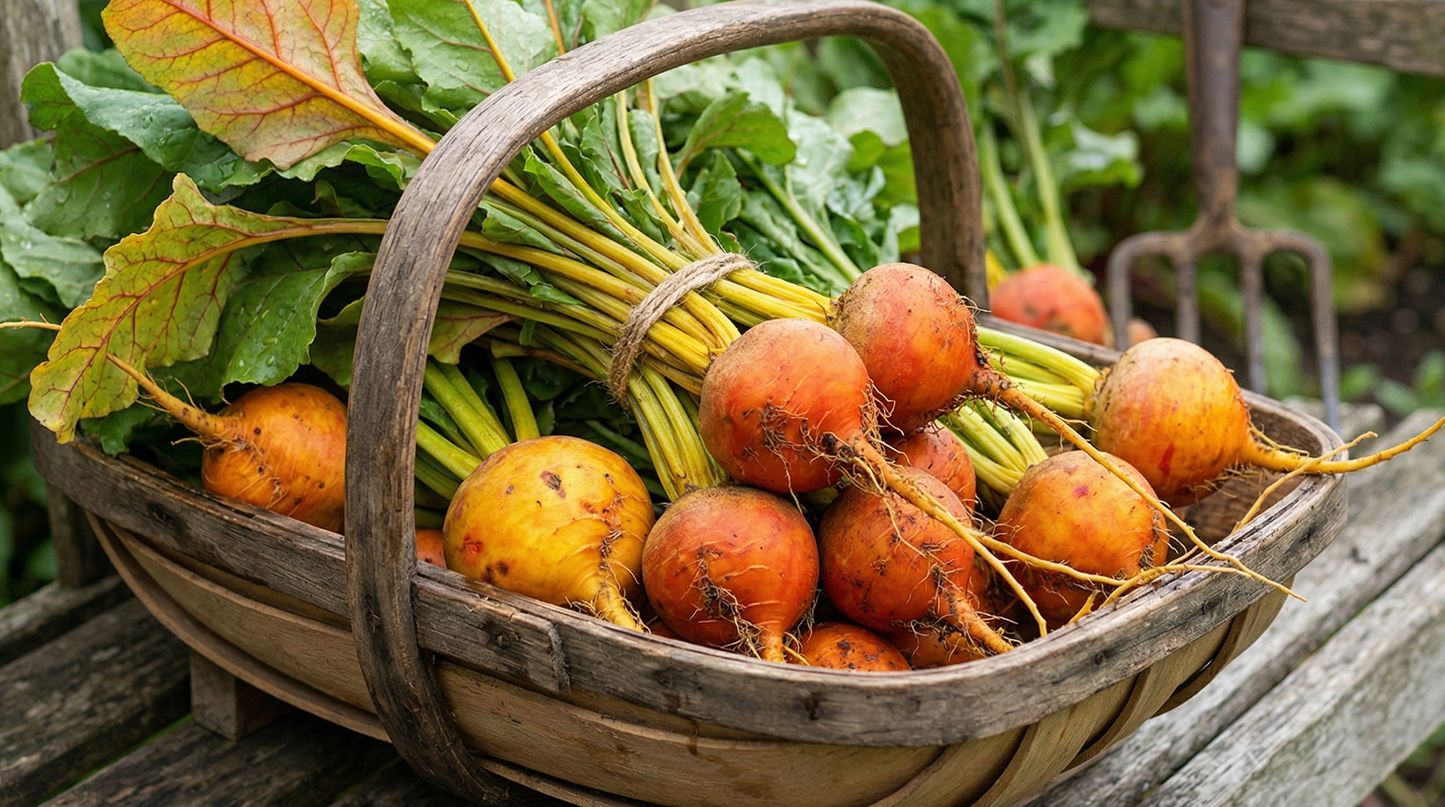
A brilliant, sun-yellow F1 hybrid with outstanding germination, perfectly round roots, and a sweet, mild flavour entirely without the earthy intensity of red varieties. Beautiful raw, extraordinary roasted, and it never bleeds.
Golden beetroot has always been an enticing prospect in the kitchen garden — the colour alone, a deep, glowing, warm yellow that turns the inside of a roasting tin into something resembling a Dutch master still life — but older varieties let the concept down with weak germination, poor uniformity, and variable flavour. 'Boldor' F1 changes this entirely. As an F1 hybrid, it brings the hybrid vigour, consistency, and germination reliability that open-pollinated golden varieties have historically lacked, and the result is a golden beetroot that is as easy, as reliable, and as productive as the best red varieties — with a flavour and visual quality that neither can match.
The roots are smooth, round, and a deep, uniform golden-yellow outside with a brilliant, luminous yellow interior that holds its colour through cooking — no bleeding, no staining of hands, boards, or the rest of the salad. The flavour is sweet and gently earthy, milder and more delicate than red beetroot, with a natural sweetness that needs no sugar and very little preparation to express itself beautifully. Roasted with a little olive oil and thyme until the outside caramelises and the interior becomes dense and honeyed; shaved raw over a salad with goat's cheese and walnuts; pickled to a bright, jewel-like gold — 'Boldor' is one of the most culinarily versatile vegetables in the kitchen garden, and one of the most visually striking when it reaches the table.
🌿 Understanding the Plant
Beta vulgaris 'Boldor' F1 is a Hardy Annual golden beetroot — an F1 hybrid variety bred by Bejo Seeds specifically to address the germination, uniformity, and vigour weaknesses that had historically limited golden beetroot varieties compared to their red counterparts. The F1 designation means it is the first-generation cross of two parent lines, producing seeds of exceptional genetic uniformity that express consistent hybrid vigour, root shape, colour, and size across every plant.
Why F1 Makes a Difference for Golden Beetroot: Open-pollinated golden beetroot varieties are appealing in concept but frequently disappointing in practice — germination rates are often lower than red varieties, root shape can be irregular, and colour intensity variable. 'Boldor' F1 eliminates all of these weaknesses through hybrid breeding, producing germination rates, root uniformity, and colour consistency that match the best red F1 varieties. For the kitchen gardener who has been disappointed by golden beetroot before, 'Boldor' is the variety that changes the experience entirely.
The No-Bleed Advantage: Red beetroot bleeds its intense pigment — betalain — onto everything it touches: hands, chopping boards, salad ingredients, other vegetables in a roasting tin. Golden beetroot contains a different, less intense pigment that does not bleed in the same way, meaning 'Boldor' can be prepared, cooked, and served without staining anything around it. This makes it uniquely practical for use alongside pale ingredients — goat's cheese, white beans, cream — that red beetroot would instantly colour. The two varieties together, red and gold, make one of the most visually spectacular salad plates in any kitchen garden repertoire.
'Boldor' alongside 'Boltardy' and 'Chioggia': The Bishy Barnabee's beetroot range now covers three visually and culinarily distinct varieties. 'Boltardy' is the classic, reliable, deep red heritage variety — bolt-resistant, sweet, all-purpose. 'Chioggia' is the candy-striped Italian heirloom with alternating pink and white rings — spectacular raw and visually unique. 'Boldor' is the golden F1 — the most culinarily versatile, the least intimidating in the kitchen, and the most dramatically beautiful when roasted to a caramelised, honeyed gold. Growing all three provides a complete beetroot harvest of extraordinary visual and flavour diversity.
🌱 Growing Guide
'Boldor' is grown in the same way as red beetroot, with the same direct sowing approach and the same preference for open, well-drained soil — but with notably better germination reliability than open-pollinated golden varieties.
How to Sow:
Sow direct outdoors from April to July — beetroot dislikes root disturbance and is best sown where it is to grow rather than transplanted. Sow seeds approximately 2cm deep in rows 30cm apart, spacing seeds 7–10cm within the row, or sow more thickly and thin to this spacing once seedlings are established. Each beetroot seed is actually a cluster of two or three seeds fused together — multiple seedlings will emerge from each sowing point and the weakest should be thinned to leave one per station. Maintain soil moisture during germination, which typically occurs within 10–14 days in warm soil.
Thinning:
Thin seedlings to 10cm apart for standard-sized roots, or 7cm for smaller, more tender roots harvested young. The thinnings are edible — small beetroot leaves are excellent in salads, with a mild, sweet flavour. Do not delay thinning, as overcrowded plants produce small, poorly formed roots.
Ongoing Care:
Keep the bed weed-free, particularly in the early stages when small beetroot seedlings can be easily overwhelmed. Water consistently during dry spells — irregular watering causes the concentric rings (zoning) visible when the root is cut, though this is purely aesthetic and does not affect flavour. 'Boldor' does not require feeding in reasonably fertile soil — avoid freshly manured ground, which encourages leafy growth at the expense of root development.
Successional Sowing:
Sow in batches every three to four weeks from April to July for a continuous harvest rather than a single large glut. Each batch will be ready approximately 55–70 days from sowing depending on the season. A late July sowing will produce roots ready to harvest in September and October — 'Boldor' stores well and late-sown roots can be left in the ground until needed through autumn.
Harvesting:
Harvest when roots reach golf-ball to tennis-ball size — approximately 5–8cm in diameter — for the best combination of tenderness and flavour. Roots left to grow larger can become woody at the centre. Twist the tops off rather than cutting them to prevent the root from bleeding during cooking. 'Boldor' stores well in a cool, dark place or in the ground under a mulch of straw through early winter.
📋 Plant Specifications
| Botanical Name | Beta vulgaris 'Boldor' F1 |
| Common Name | Golden Beetroot / Yellow Beetroot |
| Plant Type | Hardy Annual |
| Hardiness | H4 — hardy; sow outdoors from April |
| Sowing Method | Direct sow outdoors — dislikes transplanting |
| Light Requirements | Full Sun / Light Shade ☀️⛅ |
| Root Colour | Deep golden-yellow skin — brilliant yellow interior |
| Root Shape | Smooth, round, uniform — excellent F1 consistency |
| Root Size at Harvest | 5–8cm diameter — harvest young for best tenderness |
| Days to Maturity | Approximately 55–70 days from sowing |
| Harvest Period | June to October (successional sowings) |
| Flavour | Sweet, mild, gently earthy — less intense than red beetroot |
| Bleeds When Cut | No — golden pigment does not stain |
| Best Uses | Roasting, raw in salads, pickling, juicing |
| Seeds per Packet | 100 seeds |
| Perfect For |
🌟Roasting & Caramelising
🥗Raw Salads & No-Bleed Cooking
🫙Pickling & Preserving
🌈Colourful Kitchen Garden Displays
📦Successional Sowing & Storing
|
🤝 Companion Planting
Beetroot is a sociable and unfussy vegetable in the kitchen garden — these companions from the range work particularly well alongside 'Boldor', supporting its growth and making the most of the space around it:
- 🌼 Calendula 'Art Shades Mixed': The Pest Deterrent. Calendula is one of the most broadly useful companion plants in the kitchen garden — its sticky stems trap aphids and whitefly, its scent confuses and deters a range of pest insects including leaf miners that occasionally affect beetroot foliage, and its open flowers attract the hoverflies and parasitic wasps that keep pest populations in check throughout the season. The warm amber and apricot tones of Art Shades Mixed alongside the golden roots and bright green-gold-veined tops of 'Boldor' creates a planting of considerable warmth and visual coherence, and the combination of edible root and edible flower in the same bed is entirely in keeping with the productive-and-beautiful philosophy of the cottage kitchen garden.
- 🌟 Borage: The Pollinator and Soil Partner. Borage is a classical companion for root vegetables — its deep taproots draw up minerals from lower soil horizons and make them available in the topsoil as the plant breaks down, improving fertility for the shallow-rooted crops growing around it. As a powerful pollinator attractor it also increases the general density of beneficial insects in the kitchen garden, creating a more balanced ecosystem that reduces the likelihood of significant pest outbreaks. The electric blue of Borage flowers alongside the golden tops of 'Boldor' makes for one of the most visually striking and most culinarily productive pairings in the summer kitchen garden.
- 🌿 Basil Classic Italian: The Aromatic Neighbour. Basil's volatile aromatic oils have a deterrent effect on aphids, thrips, and other soft-bodied pest insects, and its bushy low habit works well alongside the upright foliage of beetroot without competing for light. More practically, growing basil alongside 'Boldor' means that the two ingredients for the finest roasted golden beetroot salad — beetroot and fresh basil — are always harvested together from the same patch. A warm salad of roasted Boldor beetroot, torn basil, crumbled goat's cheese, and a little balsamic is one of the simplest and most satisfying things the summer kitchen garden produces.
- 🔴 Beetroot 'Boltardy': The Complete Beetroot Pairing. Growing 'Boldor' F1 alongside 'Boltardy' in the same bed is the simplest and most rewarding way to make the most of both — the deep, glossy red roots and the brilliant golden roots harvested together, roasted side by side until caramelised, and served together on the same plate in a combination of colour and flavour that is one of the great vegetable presentations of the British kitchen garden. Both varieties share the same growing requirements and the same harvest window, making them completely natural bedfellows, and the visual contrast between the two colours in the garden — red roots and golden roots emerging from the same soil — is as beautiful as the contrast on the plate.
📅 Sowing & Harvest Calendar
Sow direct outdoors from April in successive batches every three to four weeks — each sowing produces golden roots ready to harvest in 55–70 days, giving a continuous supply of brilliant yellow beetroot from June right through to October.
| Jan | Feb | Mar | Apr | May | Jun | Jul | Aug | Sep | Oct | Nov | Dec | |
|---|---|---|---|---|---|---|---|---|---|---|---|---|
| 🌱 Sow Direct | ||||||||||||
| 🌟 Harvest |
Two habits make the most of 'Boldor'. First, sow in small batches every three to four weeks rather than a single large sowing — a row of twenty roots every month from April to July gives you a steady supply of perfectly sized golden beetroot throughout summer and into autumn, which is far more useful in the kitchen than a single large harvest that all needs eating or storing at once. Second, harvest on the young side — roots at 5–7cm across are sweeter, more tender, and more visually perfect than roots left to grow large. The larger a beetroot grows, the more likely the centre is to become dense and slightly woody; 'Boldor' at peak perfection is the size of a large golf ball, still sweet through to the core, with the thin skin that needs no peeling before roasting. Twist the tops off rather than cutting them — this simple step prevents the root from bleeding colour during cooking and keeps the golden flesh as vivid on the plate as it was in the ground.
🌟 The Golden Beetroot That Finally Delivers
Beta vulgaris 'Boldor' F1 is the golden beetroot the kitchen garden has been waiting for — an F1 hybrid with the germination reliability, root uniformity, and colour intensity that older golden varieties promised but rarely delivered, combined with a sweet, mild flavour and a no-bleed quality that makes it uniquely versatile in the kitchen. Grow it alongside 'Boltardy' for the most visually spectacular beetroot harvest the garden can produce, sow it in succession from April to July for a continuous supply through the season, and roast it simply with olive oil and thyme until caramelised and deeply golden — one of the finest and most effortlessly beautiful things the summer kitchen garden has to offer.
📖 Want more detailed growing advice?
View our Complete Growing Guide →
Share