Comfrey
Comfrey
Couldn't load pickup availability
Symphytum officinale 'Common Comfrey' The kitchen gardener's secret weapon — the plant grown for the soil, not the plate
Of all the herbs in our catalogue, comfrey is the genuine outlier — the one you grow not to eat, but to feed everything else in the garden. To the working organic gardener, it's one of the single most useful plants you can establish: a tap-rooted, deep-mining mineral accumulator that draws potassium, calcium and magnesium up from the subsoil, transforms them into vast quantities of nutrient-rich leaf, and gives you the raw material for one of the most effective natural fertilisers known to British gardening. A patch of comfrey at the back of the kitchen garden is worth a winter's worth of plant feed, and asks for almost nothing in return.
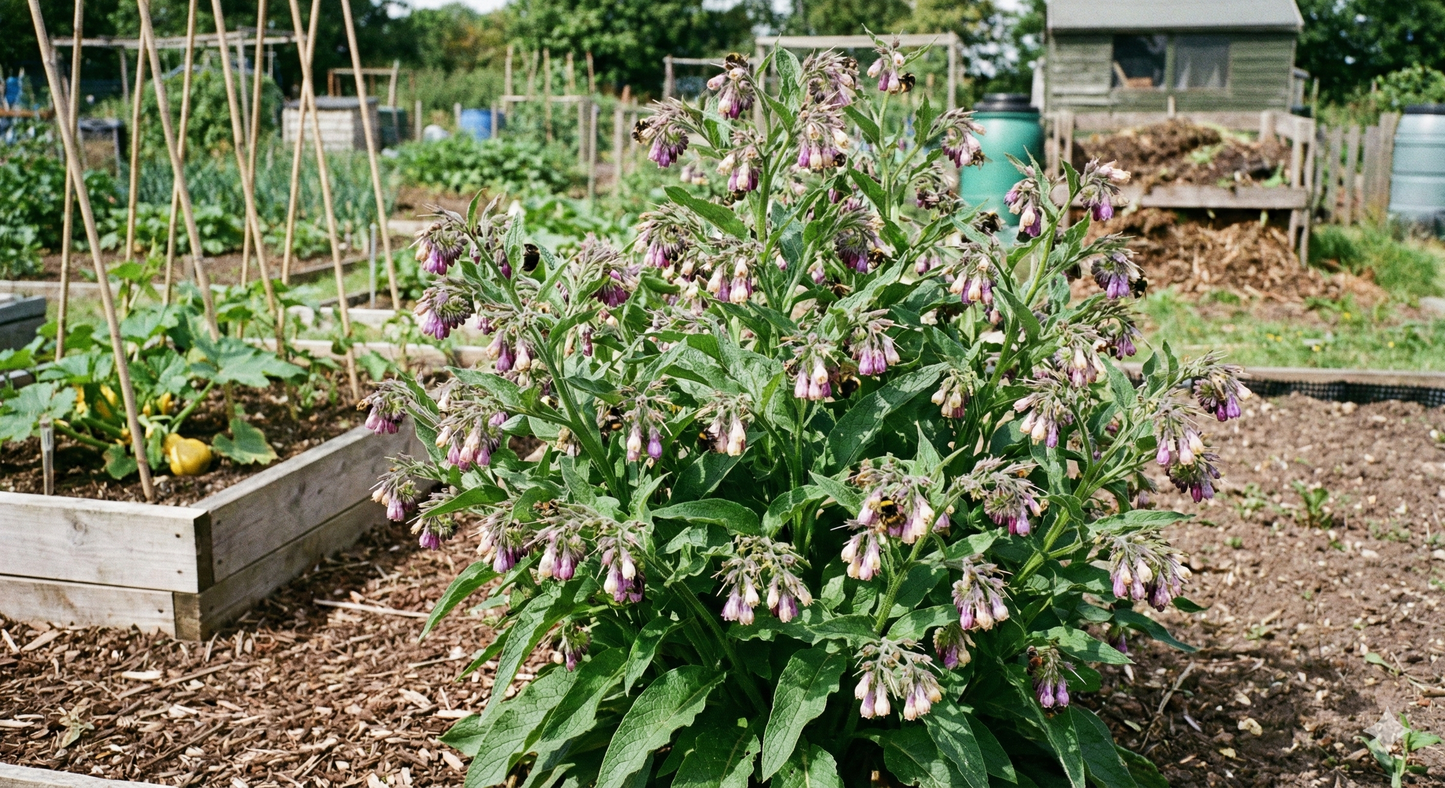
Common Comfrey is the traditional native species — a substantial hardy perennial growing to around 90 to 120cm, with deep, bristly green leaves, a stout fleshy taproot, and clusters of nodding tubular flowers in shades of purple, pink and creamy white through the summer. The flowers are properly loved by bumblebees — comfrey is on the RHS Plants for Pollinators register — and a mature plant in flower can be quite alive with foragers on a warm June morning. Lovely in itself, and useful in three quite different ways.
What you'll actually use it for
Comfrey earns its space in the garden through one famous trick and several quieter ones:
- Comfrey tea (liquid fertiliser) — the headline use. Cut leaves, stuff them into a bucket or barrel with a weight on top, cover with water, and leave for three to six weeks. The result is a dark, properly smelly, high-potassium liquid feed that's brilliant for tomatoes, peppers, chillies, beans, fruit bushes, cucurbits and any flowering or fruiting plant. Dilute roughly one part comfrey tea to ten parts water before applying. A few mature plants will produce more than enough feed for a substantial kitchen garden through the growing season.
- Mulch — cut leaves wilted overnight and tucked around the base of greedy feeders (tomatoes, courgettes, runner beans) break down quickly and release their nutrients straight into the soil. The simplest use of all.
- Compost activator — comfrey leaves added in layers to a compost heap accelerate decomposition. A barrowful of comfrey mixed through a heap of autumn leaves and grass clippings turns into useable compost noticeably faster than the same heap without.
- Bee plant — the nodding tubular flowers are amongst the best pollinator plants you can grow. Bumblebees in particular love comfrey, and a mature patch hums on a warm day.
For anyone trying to garden without bought chemical fertilisers, comfrey is one of those plants that quietly transforms what's possible. The combination of liquid feed, mulch, compost activator and bee plant in a single hardy perennial is genuinely hard to beat.
An honest word before you sow
Comfrey is a working plant rather than a tidy ornamental, and it pays to know what you're getting into before you plant it:
- It's vigorous. A mature plant is a substantial thing — broad-shouldered, leafy, occasionally floppy — and it spreads through self-seeding and through its deep taproot. Common comfrey self-seeds enthusiastically; consider whether you want that
- It's almost impossible to get rid of. The taproot can regenerate from the smallest fragment left in the soil. Once you have comfrey, you tend to have comfrey forever. Site it somewhere you're sure you want it — an unused corner, the edge of an allotment, a dedicated patch behind the shed
- It's not a kitchen herb. Despite its old name "knitbone" and a long medicinal tradition, comfrey contains compounds (pyrrolizidine alkaloids) that can damage the liver if consumed, and is no longer considered safe to take internally. Grow it for the garden, not for the table
- It's a slow starter from seed. Germination can be patchy and slow; the seeds benefit from a cold spell to break dormancy. First-year plants are modest; the real productivity comes from year two onwards as the taproot develops
None of this should put you off — if anything, the fact that comfrey is properly serious about being in your garden is what makes it so useful. Just plant it where you mean to keep it.
A note on growing
Comfrey seeds need a period of cold to germinate well — nature's own dormancy break. There are two practical approaches:
- Sow direct in autumn (October to November), letting winter do the stratification for you. Seeds germinate the following spring when the soil warms. This is the easiest route
- Cold-stratify and sow in spring — mix the seeds with a little damp vermiculite or sand in a plastic bag, refrigerate for two to four weeks, then sow in modules or direct from March to May
Sow about 1cm deep into a well-prepared seedbed in a sunny or partly-shaded spot — comfrey isn't fussy about soil but does best in deep, moist ground where the taproot can develop properly. Germination can be slow and patchy — allow two to six weeks. Thin or transplant the seedlings to 60 to 90cm apart — this is a large plant and crowding it reduces yield.
First-year plants establish the taproot and put on modest growth. From the second year, the plants come into their own — producing flushes of large leaves through spring and summer that you can cut back hard (down to a few inches above the ground) three or four times a season. The plant simply regrows, faster and stronger each time. Cut leaves go straight to the comfrey-tea barrel, the compost heap, or the mulch pile.
Comfrey is genuinely undemanding once established. Water in dry spells in its first year; thereafter the deep taproot finds its own moisture. Don't feed — the whole point of comfrey is that it generates fertility from the subsoil. Tolerates partial shade but most productive in sun.
Where it shines
The right place for comfrey is the productive end of the garden:
- An unused corner of the allotment or kitchen garden — ideally near the compost heap and the water butt, where harvesting the leaves and making the tea are both easy
- Behind a shed or along a fence-line — comfrey is happy in awkward spots where you can't easily plant anything else
- The edge of an orchard — the deep taproot doesn't compete with fruit-tree roots, and the leaves provide a steady supply of mulch for the trees themselves
- A dedicated "useful plants" patch — alongside other workhorse plants like nettles (the other classic liquid-fertiliser plant), borage and yarrow
- A bee-friendly border — if you can spare it the space, comfrey is one of the finest bumblebee plants you can grow
What we wouldn't recommend: planting it in a small ornamental bed where you might later regret it. Comfrey is for somewhere you mean to have it permanently.
At a glance
- Type: Hardy perennial (Symphytum officinale) — comes back every year, lives for decades
- Height: 90–120cm; Spread: 60–90cm; Spacing: 60–90cm
- Flowers: June to August — nodding purple, pink and cream tubular clusters, beloved of bumblebees
- Sow: Direct in autumn (Oct–Nov), or cold-stratify and sow in spring (Mar–May)
- Position: Full sun or partial shade; moist deep soil; don't feed
- Care: Once established, almost no care needed. Cut leaves 3–4 times a season from year two
- RHS Plants for Pollinators — one of the best bumblebee plants
- Uses: Liquid fertiliser ("comfrey tea"), mulch, compost activator, bee plant. NOT for internal/culinary use
- Important: Self-seeds; almost impossible to remove once established — site permanently
Plant alongside
Comfrey works best in productive, working-garden company. Plant alongside French Marigold 'Spanish Brocade' and Calendula 'Neon' for layered pollinator and pest support, or amongst fruit trees, currants, gooseberries, and the back of the vegetable patch. Nettles (if you can stand them) make the obvious working-garden partner — nettle tea and comfrey tea together cover most of what a productive garden needs. Borage is another excellent companion: another deep-rooted, bee-loved, self-seeding workhorse plant.
Share