Cress Common
Cress Common
Couldn't load pickup availability
Common Cress Microgreens Seeds
Britain's oldest and most loved sprouting crop — sharp, clean, and distinctly peppery, ready to cut in as little as five days and as at home in a school classroom as a professional kitchen. The microgreen that started it all.
Of all the microgreens in the Bishy Barnabee's range, common cress has the longest and most affectionate relationship with the British public. Almost every person who grew up in Britain in the last century has grown cress — on damp kitchen paper, in an eggshell, on a wet flannel on a primary school windowsill — and the memory of those first tiny, peppery shoots cut with blunt scissors and eaten straight from the container is one of the most universal and most warmly remembered first encounters with gardening there is. Cress is where British growers begin, and it is where they return.
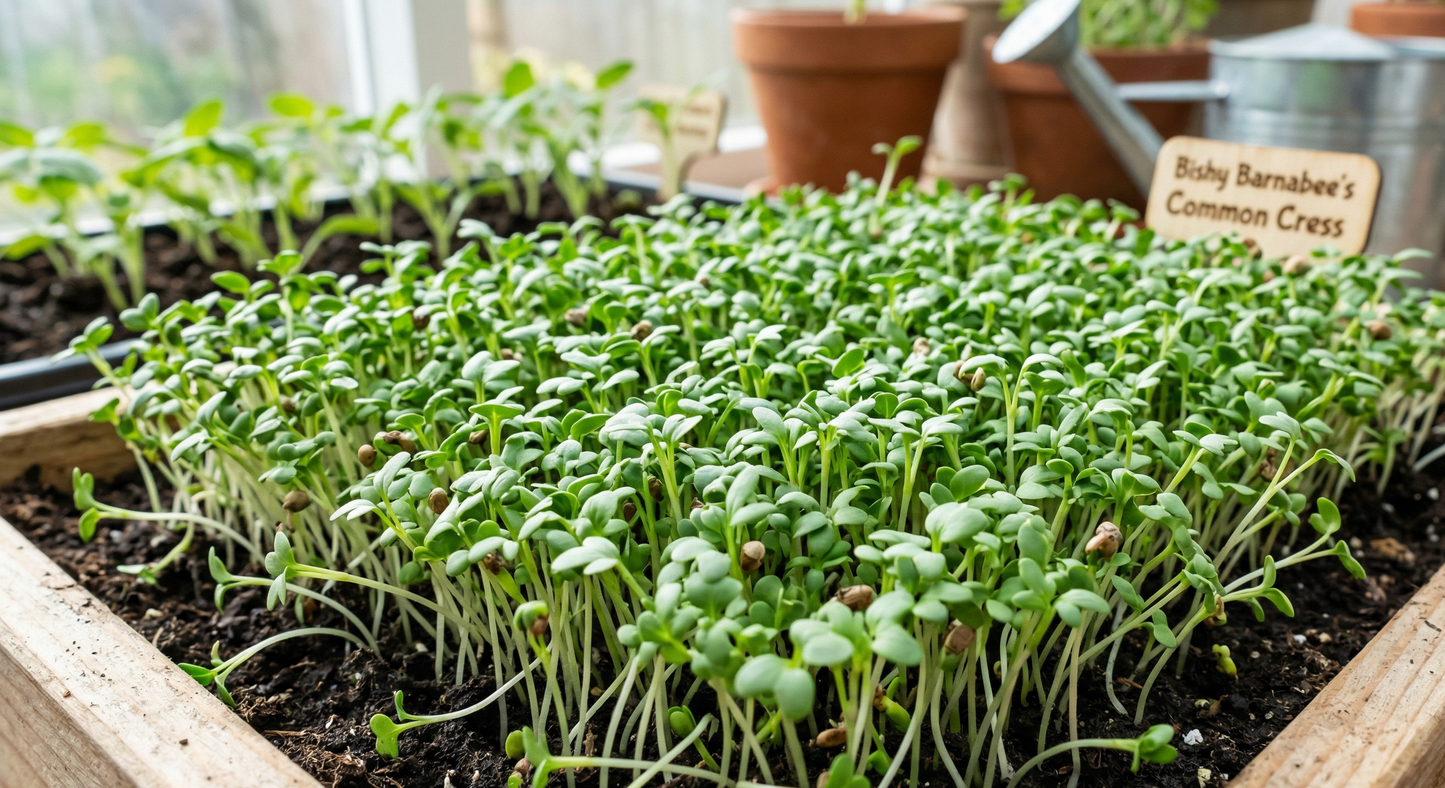
But common cress is far more than nostalgia. The flavour is sharp, clean, and distinctly peppery — not the deep, fiery heat of Rambo Radish or the warm nuttiness of rocket, but a bright, immediate, almost aquatic sharpness that is entirely its own and unmistakably vivid on the palate. The shoots are fine, upright, and bright green, ready to cut in as little as five days on a warm windowsill, and they require less equipment and less preparation than any other microgreen in the range. A sheet of damp kitchen paper in a saucer is sufficient. This is the most democratic crop in the kitchen garden — as accessible to a five-year-old with a flannel as to a Michelin-starred chef finishing a tartare, and equally at home in both contexts.
🌿 Understanding the Crop
Lepidium sativum, common cress or garden cress, is a Hardy Annual brassica native to Western Asia and North Africa, cultivated as a food crop for at least three thousand years and naturalised widely across Europe and the British Isles. It is botanically distinct from watercress (Nasturtium officinale), which grows in running water, and from American land cress — it is the fine-leaved, fast-growing, upright sprouting cress sold in punnets at every British supermarket and grown on kitchen paper by generations of British schoolchildren. As a microgreen it is one of the easiest, fastest, and most forgiving crops in the entire growing world.
🍳 The Kitchen Classic
Egg and cress sandwiches are one of the great enduring combinations of the British kitchen — the cool creaminess of egg mayonnaise against the sharp, clean pepper of fresh cress on good white bread. Cress also finishes soups, tops smoked fish, garnishes devilled kidneys, and sits alongside cold meats on a summer board with a quiet, confident authority.
🌱 The First Garden
Common cress grown on damp kitchen paper is the first gardening experience for millions of British children — and with good reason. It germinates within 24 hours, is ready to harvest in five days, needs no soil, no pot, and no experience, and produces a crop that is genuinely delicious. There is no faster or more confidence-building first growing success available to a child or a beginner.
The Flavour Chemistry: Cress's sharp, clean, peppery flavour comes from glucotropaeolin — a glucosinolate compound that converts to benzyl isothiocyanate when the plant tissue is cut or chewed. This compound is closely related to but distinct from the isothiocyanates in radish and rocket microgreens, producing a flavour that is sharper, cleaner, and more immediately volatile than radish heat — present and vivid for a moment and then gone, rather than building and lingering. This characteristic makes cress a particularly versatile flavour element — it brightens a dish without dominating it.
The Simplest Growing Method in the Range: Common cress is the only microgreen in the Bishy Barnabee's range that grows well on nothing more than damp kitchen paper. The mucilaginous seed coat of cress — which becomes sticky and gel-like when wet, anchoring the seed to any damp surface — means it requires no growing medium beyond moisture and a surface to cling to. This makes it the most accessible entry point to microgreen growing, suitable for any household regardless of whether they have any growing equipment at all.
The Mucilaginous Seed: When wetted, cress seeds develop a transparent, gel-like coating — a characteristic known as myxospermy, shared with basil and chia seeds — that causes them to adhere firmly to any damp surface. This is not mould; it is a natural and desirable quality that anchors the seeds in place without any growing medium and helps retain the moisture the germinating seedling needs. Do not rinse seeds before sowing — this coating is essential to the process.
🌱 Growing Guide
Common cress is the most forgiving and most beginner-friendly crop in the entire Bishy Barnabee's range — faster than any other microgreen, requiring less equipment than any other, and succeeding reliably in the hands of a child as readily as an experienced grower.
Kitchen Paper Method — The Simplest Possible Approach:
Day 0: Fold two or three sheets of kitchen paper to fit a saucer, shallow dish, or any flat container. Dampen thoroughly with water — the paper should be fully wet but not swimming in standing water. Scatter cress seeds evenly across the surface. Do not pre-soak, do not press in — simply scatter and leave. The mucilaginous seed coat will anchor the seeds in place as they absorb moisture. Cover loosely with a second sheet of kitchen paper or a light cloth to maintain humidity during germination. Keep at room temperature — 18–22°C is ideal but cress tolerates cooler conditions well.
Days 1–2: Germination begins within 24 hours — faster than any other microgreen in the range. Remove the cover once the majority of seeds have germinated and the shoots are beginning to straighten. Move to a bright windowsill.
Days 4–6: Harvest with scissors when shoots are 3–6cm tall and the seed leaves are fully open and vivid green. Cut just above the paper. Rinse gently and use immediately — cress is at its finest eaten within minutes of cutting.
Tray Method with Compost:
For larger quantities or a more substantial crop, cress can also be grown in a shallow tray of moist seed compost or vermiculite, sown in exactly the same way as radish and rocket microgreens. The tray method produces slightly larger, more vigorous shoots than the kitchen paper method and is better suited to producing quantities for cooking rather than garnishing. Harvest at 5–7 days.
Continuous Supply:
Because cress is ready so quickly, a new sowing every four to five days produces the most seamless continuous supply — by the time one batch is fully harvested, the next is already at the germination stage. Two saucers or trays staggered four to five days apart is sufficient for most households.
Important Note on the Seed Coat:
Do not rinse cress seeds before or during growing — unlike alfalfa and pea shoots, cress must not be disturbed once sown. The gel-like seed coat that forms on wetting is the plant's natural anchor and moisture reservoir. Rinsing removes this coating and dramatically reduces germination success. Simply keep the paper or growing medium consistently moist by misting gently from above.
📋 Crop Specifications
| Botanical Name | Lepidium sativum |
| Common Name | Common Cress / Garden Cress / Mustard and Cress |
| Crop Type | Microgreen / Sprouting Seed |
| Growing Method | Damp kitchen paper, shallow tray, or any moist surface — no growing medium required |
| Pre-Soaking | Never — mucilaginous seed coat must not be disturbed before sowing |
| Days to Harvest | 4–6 days — the fastest microgreen in the range |
| Harvest Period | Year-round indoors at room temperature |
| Regrowth | Limited — occasional second flush possible; a fresh sowing every 4–5 days is more reliable |
| Shoot Height at Harvest | 3–6cm — fine, upright, bright green |
| Flavour Profile | Sharp, clean, bright pepper — volatile and vivid, lighter than radish heat |
| Minimum Equipment | A saucer and kitchen paper — no tray, no compost, no tools required |
| Seeds per Packet | Approximately [TBC] seeds |
| Perfect For |
🥚Egg & Cress Sandwiches
🌱First Growing Experience for Children
⚡Fastest Harvest — 4–6 Days
🪟No Equipment Needed — Just a Saucer
🎨Year-Round Windowsill Growing
|
Nutritional Highlights:
🍽️ Using Your Microgreens
Common cress is the most immediately usable microgreen in the range — its flavour is universally familiar, its uses span from the humble to the haute, and its sharp, clean brightness improves almost any savoury dish it touches.
Egg and Cress — The Irreplaceable Classic:
The combination of egg and cress is one of the great enduring pairings of British food — as right and as satisfying as it has ever been. Egg mayonnaise sandwiches with freshly cut cress on good white bread, crusts removed if the occasion demands; softly scrambled eggs with a pile of cress scattered over the top just before serving; a soft-boiled egg with a small heap of cress alongside and good butter — these are dishes of deceptive simplicity and genuine, lasting pleasure. The cool, creamy egg and the sharp, vivid cress need each other in a way that neither ingredient fully explains but every palate immediately recognises.
Smoked Fish:
Cress and smoked fish — smoked salmon, hot-smoked mackerel, smoked trout, kippers — is another classic British pairing of considerable depth. The sharp pepper of the cress cuts through the rich, oily flesh of the fish with vivid precision, and the combination on brown bread with good butter and a squeeze of lemon is a lunch of straightforward, confident excellence. Scatter generously and without restraint.
Soups:
A small pile of freshly cut cress placed in the centre of a bowl of cream of potato soup, vichyssoise, or a simple watercress soup creates both a visual focal point and a bright flavour contrast — the pepper of the cress cutting through the richness of the cream base with exactly the precision the dish needs. The classic British combination of potato and cress in soup form is one of the finest and most underrated pairings in the national culinary repertoire.
Sandwiches, Toast, and Boards:
Cress is the natural finishing touch for any open sandwich, toast topping, or cold board — its fine, upright shoots pile beautifully, its green colour is fresh and vivid, and its flavour is lively enough to contribute without dominating. Use alongside cold chicken, smoked meats, cream cheese and cucumber, or any combination that benefits from a bright, peppery note at the finish.
Tartare and Raw Fish:
Finely cut cress scattered over a beef or tuna tartare provides both flavour and visual texture — the sharp pepper works beautifully against the rich, oily rawness of the fish or meat, and the fine green shoots frame the dish with a freshness that heavier garnishes cannot match. This is the professional kitchen use of cress that sits alongside the schoolroom one and is equally valid.
Storing:
Cress is best cut and eaten immediately — the volatile compounds responsible for its sharp flavour begin to diminish within hours of cutting. If storing, rinse gently and keep loosely in the fridge for no more than one to two days. The most practical approach is to keep a live saucer or tray on the windowsill and cut as needed, taking only what will be used at each meal. A fresh sowing every four to five days maintains this approach indefinitely.
📅 Year-Round Growing Calendar
Sow every four to five days on a damp saucer or windowsill tray for a completely continuous supply of sharp, bright cress in every month of the year — the fastest, simplest, and most democratic crop in the entire growing range.
| Jan | Feb | Mar | Apr | May | Jun | Jul | Aug | Sep | Oct | Nov | Dec | |
|---|---|---|---|---|---|---|---|---|---|---|---|---|
| 🌱 Sow Indoors | ||||||||||||
| ✂️ Harvest |
Two things define success with common cress. First, never rinse the seeds before or during growing — the mucilaginous gel coating that forms on wetting is what anchors the seeds and retains moisture for the germinating seedling. Rinsing removes it and sharply reduces germination success. Keep the paper or compost consistently moist by misting gently from above rather than watering from below, and never let it dry out completely. Second, keep a live saucer of cress on the kitchen windowsill at all times and cut directly into whatever you are cooking rather than harvesting the whole tray at once — cress is at its sharpest and most vivid the moment it is cut, and the most satisfying way to use it is to snip a small amount over a dish immediately before serving, exactly as you would a fresh herb. This is the approach that makes the most of cress's extraordinary speed and the most of its extraordinary flavour.
🏆 Britain's Most Beloved First Crop
Lepidium sativum holds a place in the British growing tradition that no other plant in the entire Bishy Barnabee's range can match — three thousand years of cultivation history, a generation of schoolchildren who grew it on wet paper as their first garden, and a permanent place in the national kitchen alongside boiled eggs, smoked salmon, and good white bread. It is the fastest, simplest, most democratic, and most nostalgically charged crop in the range — and it is also, when freshly cut and eaten within minutes, one of the finest and most vividly flavoured. Grow it on a saucer, cut it with scissors, eat it immediately. There is nothing simpler, and very little better.
📖 Want more detailed growing advice?
View our Complete Growing Guide →
Share