Dried Nigella Flowers | Love-in-a-Mist Norfolk Bunch
Dried Nigella Flowers | Love-in-a-Mist Norfolk Bunch
Couldn't load pickup availability
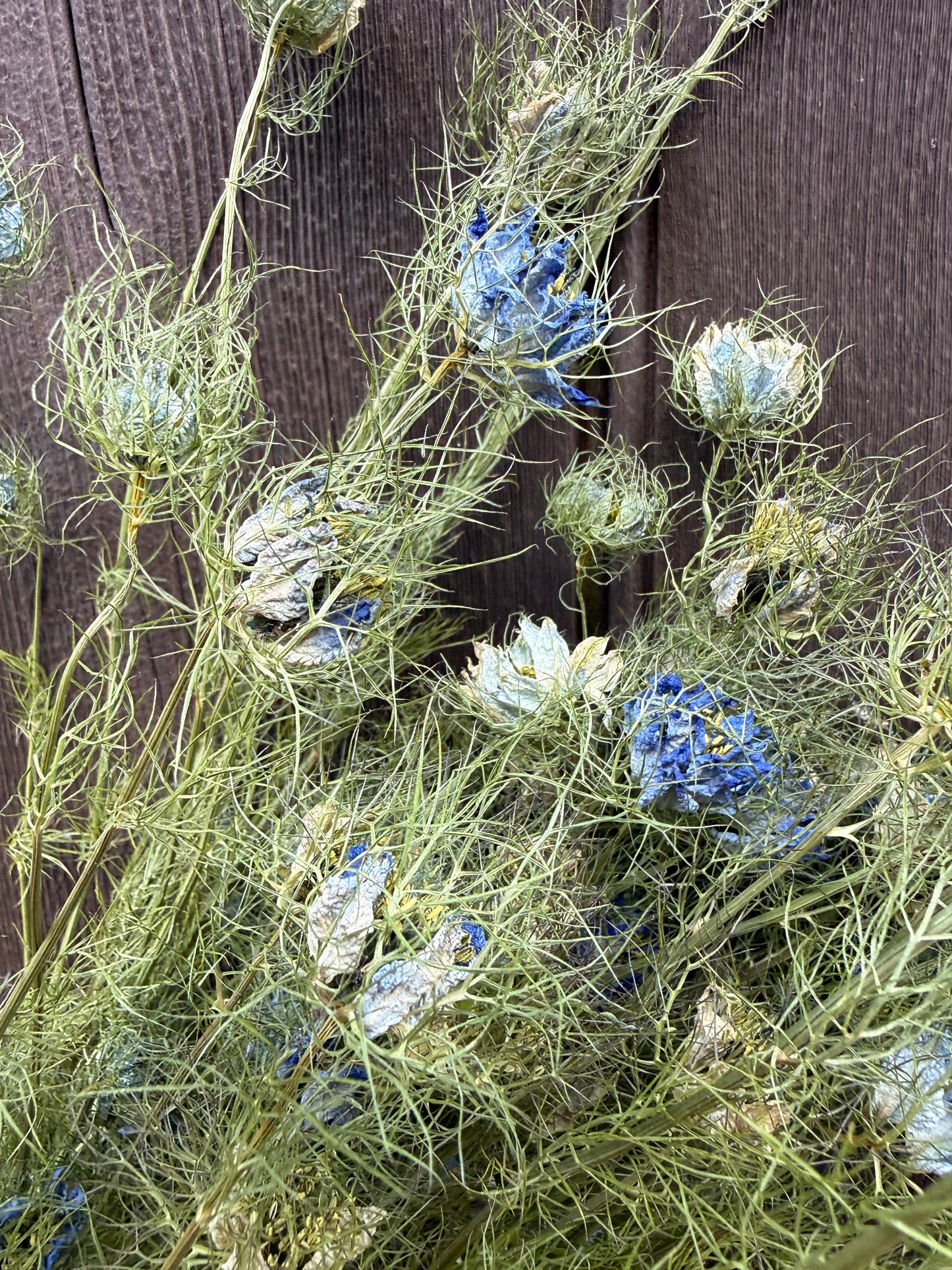
The other half of the Nigella story. If our Nigella Seed Head bunches are the plant at its architectural late-season stage, these are the same plant caught two months earlier — at the peak flowering moment when the distinctive five-petalled stars are fully open and haloed by the spidery filaments that give Love-in-a-Mist its common name. Delicate rather than structural. Coloured rather than papery. Ethereal rather than sculptural. One of the very few dried flowers that keeps genuine blue in its colour palette, alongside softer pinks, mauves, whites and creams that the mixed-variety plants produce naturally.
Barn-dried at Salle Moor Hall, Norfolk. Bunches of 20 stems, each 45-60cm long, with the flowers 3-4cm across and the fine "mist" foliage preserved around each stem. Hand-harvested at the exact moment when flowers have opened fully but before the petals start to fall, then hung upside-down to dry naturally in the barn to preserve both the flower shape and the delicate colour. Grown chemical-free on our own cutting field from the mixed-colour variety that produces the full range of blues, mauves, whites and pinks within a single bunch. Seasonal, available while our summer stock lasts.
The Love-in-a-Mist plant
Nigella damascena is a member of the Ranunculaceae family (buttercup relatives) — hardy annual, quintessentially cottage garden, and one of the easiest and most rewarding plants to grow from seed. The common name "Love-in-a-Mist" refers to the spidery finely-divided foliage that surrounds each flower like a cloud of green mist. This foliage dries alongside the flowers and is properly part of the product's character — not just supporting greenery but the visual mist that gives the plant its charm and its name.
What makes this bunch distinctive
- Actual retained blue — blue is famously the hardest colour to preserve through drying (most dried flowers fade blue to grey), but Nigella damascena is one of the small handful of species where the blue pigments hold their character. Not electric blue, but a soft dusky blue that keeps for years. Genuinely rare in the dried flower world
- Mixed colour palette in every bunch — the mixed-variety plants produce blue, white and pink flowers within a single planting. Your bunch will contain a naturally-varied colour mix rather than a single colour
- The spidery mist foliage — extremely fine, thread-like bracts that surround each flower like a green halo. Preserves the "mist" quality that gives the plant its common name and creates an ethereal, delicate visual effect
- Five-petalled star flower shape — each flower is a distinctive star with prominent stamens, quite unlike the round-headed flowers of most dried products. Instantly recognisable
- Delicate scale — 3-4cm flowers on wiry stems give an "airy filler with colour" quality that's rare in dried floristry — most airy fillers are neutral, most coloured flowers are dense. Nigella flowers combine both
- Two harvests from one plant — Nigella is generous. If you grow your own, you can pick some flowers early for drying (this stage), leave others on the plant, and harvest the inflated seed pods later (our Seed Head product). One plant, two entirely different dried products
Styling ideas
- Cottage garden wedding bouquets — the soft dusky blues and mauves work beautifully alongside cream and white dried flowers for country weddings. One of the few dried flowers that adds actual delicate colour to bridal work
- Airy filler in mixed dried bouquets — where big-headed statement flowers (helichrysum, achillea, hydrangea) can feel dense, Nigella flowers with their mist foliage add space and colour movement between them
- Framed pressed-flower art — the delicate star flowers press beautifully and are one of the classic pressed-flower choices. Individual flowers translate perfectly to greeting cards, pressed-flower jewellery, and shadow-box art. The retained blue is the key selling point for pressed-flower work
- Modern minimalist arrangements — three or five stems in a plain glass bottle, standing tall with nothing else. The delicate scale and unusual flower shape read as considered sculpture
- The complete Nigella arrangement — combine with our Nigella Seed Heads from the same plant, showing both stages of the life cycle together. Botanically-informed styling that appeals to gardeners
- Delicate cottage wreaths — the fine stems bend easily into wreath rings, and the mixed-colour flowers give focal points without dominating the overall composition. Particularly good with dried grasses and cream-toned dried flowers
- Kitchen and studio displays — the ethereal quality suits studio, gallery, and kitchen environments where the light is generally consistent (protecting the colour) and the delicate aesthetic reads as considered
Perfect dried companions
- Nigella Seed Heads — the direct botanical partner. Same plant, different stage. Genuinely lovely to display them together
- Dried Achillea 'Ballerina' or Feverfew — the soft cream-white filler that flatters the mixed Nigella colour palette
- Dried Bunny Tails — the plush contrast that softens Nigella's delicate flowers with substantial texture
- Dried grasses (wheat, reed) — the natural straw tones that let the Nigella colours read fresh and distinct
- Dried Hesperis Sweet Rocket — the wildflower companion for meadow-style arrangements
- Dried Cornflower Seed Heads — the cottage garden partnership that captures the character of a summer meadow
Care note. Nigella flowers are among the more delicate dried elements — the fine mist foliage and the individual petals can be slightly fragile compared with more robust dried products. Handle from the base of the bunch. The retained blue colour is UV-sensitive (as with all blue-pigment plants) — keep out of direct sunlight, particularly south-facing windowsills, to preserve the colour for years rather than months. Store dry, away from steam and damp environments. Given proper care, the character holds for several years.
Growing your own. Nigella damascena is one of the easiest and most rewarding hardy annuals — direct-sown in autumn for large early-summer flowering plants, or in April for later flowering. Self-seeds prolifically once established, so a single sowing typically gives you a colony that returns year after year. If you leave some flowers on the plants and pick others early, you can harvest both this dried flower product and the inflated seed pods (our Seed Head product) from the same plants. Bishy sells Nigella seeds in the annual flower seed range — growing your own gives you the summer garden colour, the autumn seed pod harvest, and the flower drying harvest, all from one packet of seed.
Share