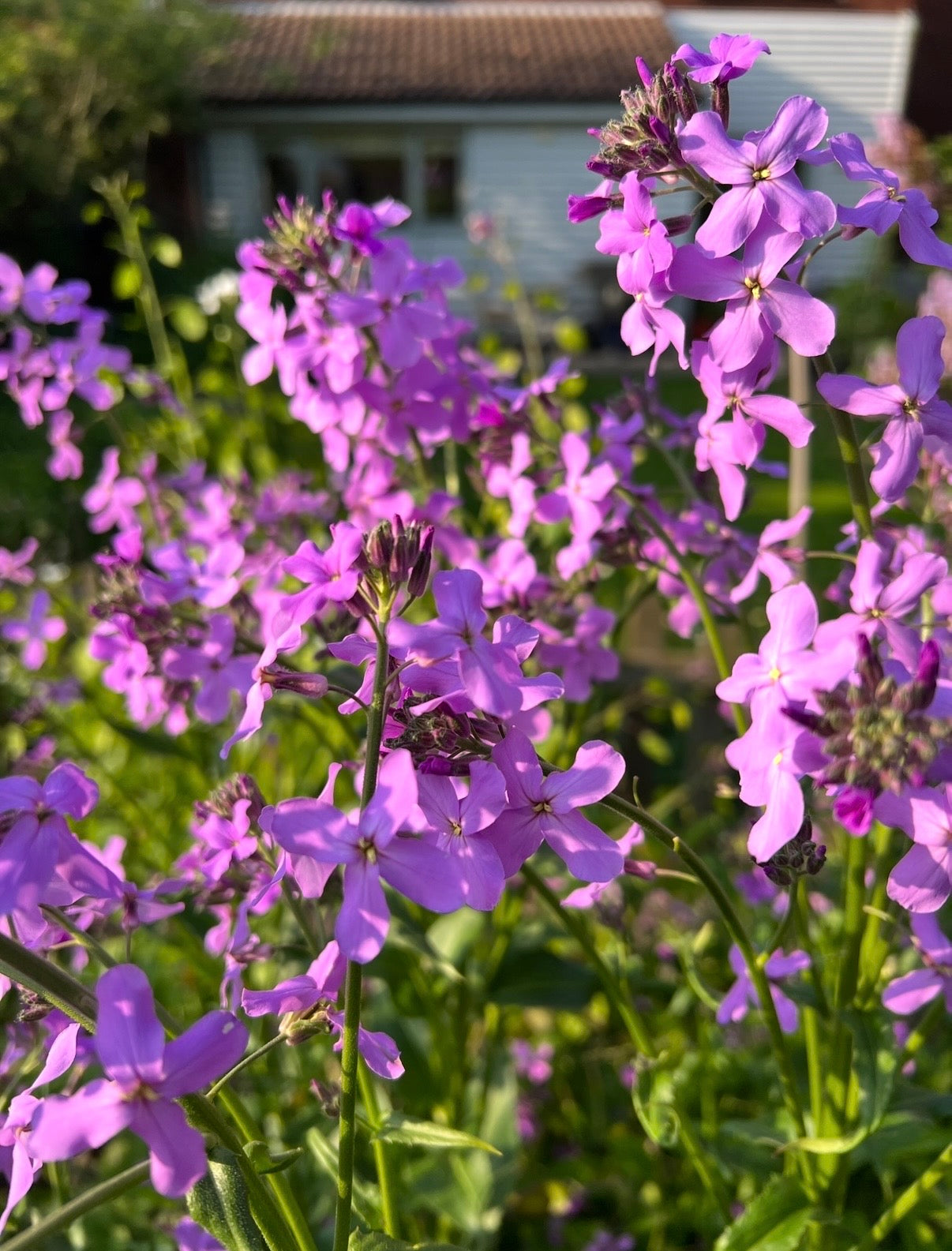
Hesperis MIxed
Hesperis MIxed
Couldn't load pickup availability
Sweet Rocket Mixed Seeds (Hesperis)
Rich violet-purple and luminous pure white — two of the most romantic cottage garden plants combined in one packet. A scented evening spectacle that fills the hungry gap between spring and summer.
There are few combinations more quietly devastating in a cottage garden than purple and white Sweet Rocket drifting together in dappled shade. This mixed packet brings together Hesperis matronalis in its classic rich violet-purple and Hesperis matronalis var. albiflora in pure, luminous white — two colours that seem made to weave between one another in a naturalistic, self-seeding colony.
Both varieties share the same extraordinary quality: as daylight fades, they release a heady fragrance of violets and cloves that intensifies with every passing hour. The purple flowers glow warmly against darkening borders, while the white blooms appear almost luminescent in the twilight. Plant them together near a seating area and they will reward every summer evening with one of the most romantic scented displays the British garden has to offer.
🌿 Understanding the Plant
Hesperis matronalis (Sweet Rocket or Dame's Violet) is a robust Hardy Perennial (H7) most commonly grown as a biennial. It is exceptionally reliable across the UK, surviving temperatures down to -20°C and returning with vigour every spring to provide tall, fragrant columns of colour at the back of the border.
The Evening Performer: The name Hesperis comes from the Greek word for evening — and this plant lives up to it entirely. Its scent is specifically evolved to attract moths for pollination, which means the fragrance intensifies dramatically as the light fades. This makes it the perfect plant for a patio, path edge, or any spot where you sit outdoors on summer evenings.
Biennial Behaviour: Sweet Rocket behaves like a foxglove or wallflower. Sow in summer, and in Year 1 it builds a leafy rosette. In Year 2 it rockets upward — to 80–100cm — and flowers spectacularly from May to July. It is a brilliant self-seeder, so once established it creates a gentle, wandering colony that refreshes itself naturally year after year.
Butterfly & Moth Hero: Listed on the RHS Plants for Pollinators list, Hesperis is a vital early-season nectar source. In spring it serves as a primary food plant for the caterpillars of the Orange Tip butterfly, and its evening fragrance draws in a host of moth species after dark.
💜 Purple Sweet Rocket
Rich, vibrant violet-purple clusters that glow warmly at dusk. Particularly striking when grown near a pale or white companion — the colour holds beautifully even in partial shade and creates a powerful sensory impact for the Orange Tip butterfly in spring.
🤍 White Sweet Rocket
Pure, luminous white spikes that become almost phosphorescent as the light fails — the original 'Moon Garden' plant. The white variety is a particularly powerful moth attractor after dark, and its reflective blooms make it invaluable for brightening shadowy corners and north-facing spots.
🌱 Growing Guide
Both varieties in this mix are grown in exactly the same way — Hesperis is one of the most beginner-friendly biennials in the cottage garden repertoire.
How to Sow:
Sow directly outdoors into a prepared seedbed from May to July. Scatter the seeds thinly and cover lightly with approximately 5mm of fine soil. Keep the area consistently moist until germination, which typically occurs within 14–21 days. Alternatively, sow in module trays indoors during spring and plant out in autumn.
Where to Plant:
Both varieties thrive in partial shade or full sun. As natural woodland edge plants, they are among the very few scented flowers that perform spectacularly under the dappled light of deciduous trees, along fences, or in north-facing borders. They prefer cool, moist, well-drained soil and are adaptable to most UK soil types.
Ongoing Care:
Move young plants to their final flowering positions in October so they can settle and experience the cold period needed to trigger flowering. Deadhead the main central spike after the first flush to encourage side shoots and extend the season into July. Leave a few heads uncut at the end of the season to allow both varieties to self-seed and build a permanent mixed colony — the purple and white will naturalise beautifully together.
A Note on Mixing:
When both colours are grown together, the plants will freely cross-pollinate and self-seed, gradually producing a naturalistic blend of white, pale lilac, and rich purple — a classic cottage garden effect that only improves with each passing year.
📋 Plant Specifications
| Botanical Name | Hesperis matronalis & H. matronalis var. albiflora |
| Common Name | Sweet Rocket / Dame's Violet |
| Colours in Mix | Rich violet-purple & pure white |
| Plant Type | Hardy Perennial (Short-lived), grown as Biennial |
| Hardiness | H7 — Ultra Hardy, to -20°C |
| Light Requirements | Part Shade / Full Sun ⛅ |
| Height | 80cm – 100cm |
| Spread | 45cm |
| Spacing | Plant 40cm apart |
| Flowering Period | May to July (Year 2 onwards) |
| Scent | Powerful violet & clove fragrance, intensifying after dusk |
| Seeds per Packet | Approximately 500 seeds |
| Perfect For |
🌙Scented Evening & Moon Gardens
🦋Butterfly & Moth Habitats
🌳Dappled Woodland Borders
🎨Romantic Purple & White Schemes
🌿Self-Seeding Naturalistic Gardens
|
🤝 Beautiful Garden Combinations
The purple and white of this mix creates its own internal contrast — but these companions from our range will elevate it further into something truly spectacular:
- ❄️ Ammi Majus (Queen Anne's Lace): The Wild Filler. The frothy white lace of Ammi Majus weaves beautifully between the purple and white Hesperis spikes, creating a light, airy, naturalistic meadow feel that is alive with pollinators. One of the great three-plant combinations in the cottage cutting garden.
- 🍋 Foxglove 'Primrose Yellow': The Woodland Contrast. Soft creamy-yellow foxglove spires towering above purple and white Sweet Rocket creates one of the most elegant early summer combinations imaginable. Yellow and purple are complementary colours, making both plants pop in a shady border — and all three thrive in the same dappled conditions.
- 🦊 Foxglove 'Excelsior Mix': The Woodland Look. For a fully naturalistic woodland border, pair the mixed Hesperis with tall speckled Foxgloves. Both plants thrive in dappled shade, flower simultaneously in June, and provide excellent vertical structure — a classic cottage garden aesthetic that peaks beautifully in early summer.
- 🪙 Honesty (Lunaria annua): The Spring Bridge. Honesty and Sweet Rocket are the perfect biennial partners — both flower in late spring, with the rich purples of Honesty acting as a vibrant foil for the glowing white Rocket beside it. Once the flowers fade, the Rocket remains lush and green while the Honesty develops its famous silver seedpods, carrying beauty into the second half of the year.
📅 Sowing & Flowering Calendar
Sow in summer for lush leafy rosettes in Year 1, followed by a towering, scented display of purple and white from May in Year 2 — and every year thereafter as the colony self-seeds.
| Jan | Feb | Mar | Apr | May | Jun | Jul | Aug | Sep | Oct | Nov | Dec | |
|---|---|---|---|---|---|---|---|---|---|---|---|---|
| 🌱 Sow Outdoors | ||||||||||||
| 🪴 Plant Out | ||||||||||||
| 🌸 Flowers (Yr 2) |
Both the purple and white flowers of Sweet Rocket are 100% edible and make a spectacular garnish — scatter the purple blooms over salads for a peppery, mustard-like note, or use the white flowers to decorate botanical bakes and summer drinks. The young leaves of both varieties are equally good in spring salads. A truly multi-purpose cottage garden plant.
🏆 RHS Plants for Pollinators
Hesperis matronalis is a powerhouse for British biodiversity. It is a crucial spring food plant for the caterpillars of the Orange Tip butterfly and provides high-value nectar for bees and hoverflies during the day — and for moths, long into the evening. Growing the purple and white together doubles the visual impact while supporting exactly the same rich community of wildlife.
📖 Want more detailed growing advice?
View our Complete Growing Guide for Biennials →
Share