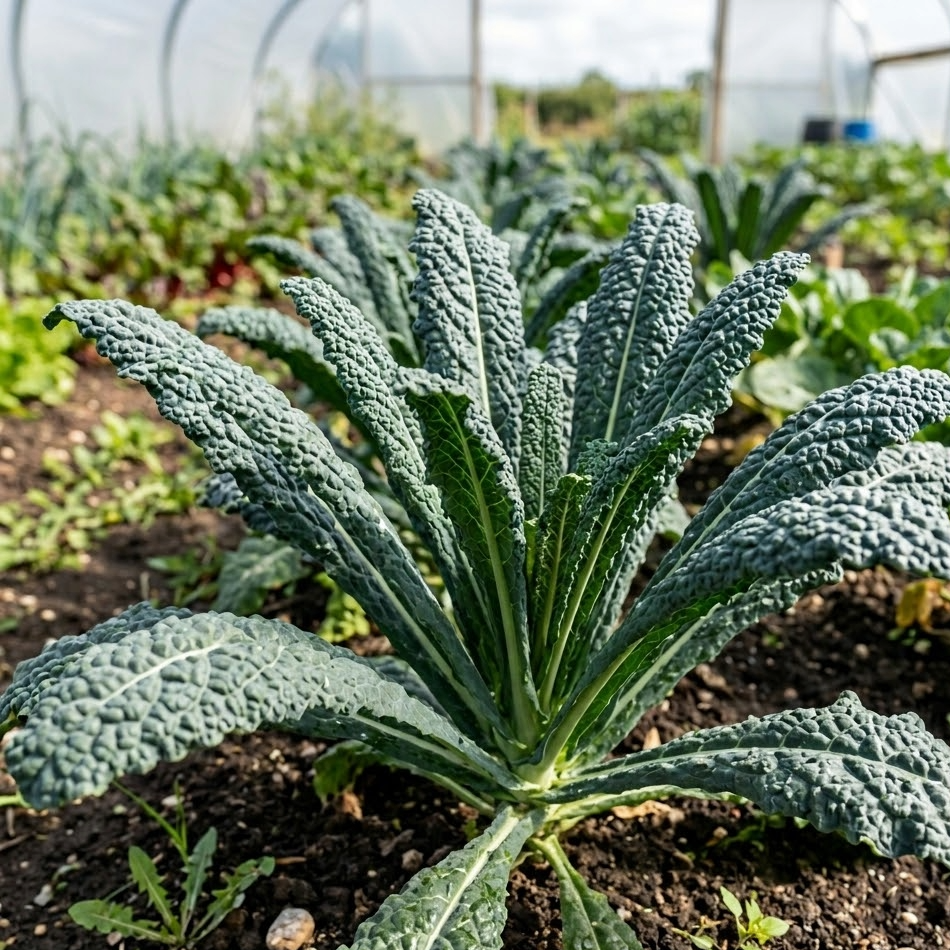
Kale Nero di Toscana
Couldn't load pickup availability
Kale 'Nero di Toscana' Seeds
The ancient kale of the Tuscan kitchen — dark as a winter forest, deeply flavoured, and frost-hardy beyond all reasonable expectation. The most beautiful and most delicious brassica in the winter kitchen garden.
There are vegetables that simply look the part, and then there is 'Nero di Toscana' — a kale so dramatically beautiful, so architecturally striking, and so deeply flavoured that it has moved from the kitchen garden into the ornamental border without apology. The long, strap-like leaves are an extraordinary near-black dark blue-green, heavily blistered and puckered in a texture that resembles embossed leather, rising from a tall central stem in a loose, open rosette that becomes more magnificent with every passing week of cold weather. It is, without question, the most visually impressive brassica available to British gardeners.
Known across Italy as 'Cavolo Nero', 'Lacinato', or 'Dinosaur Kale', this ancient Tuscan variety has been cultivated in the kitchen gardens of Tuscany for at least three hundred years and forms the backbone of ribollita — the great Florentine winter soup — alongside cannellini beans and stale bread. The flavour is deep, complex, and distinctly mineral, with a satisfying bitterness that mellows after the first frosts into something far more rounded and sweet. It is a kale that rewards cooking with patience and good olive oil, and one that makes immediately clear why Italian peasant cooking elevated it to a national institution.
🌿 Understanding the Plant
Brassica oleracea var. palmifolia 'Nero di Toscana' is a Hardy Biennial grown as an annual or biennial vegetable crop. It belongs to the same species as cabbage, broccoli, and Brussels sprouts — the oleracea group of the brassica family — but is a distinct botanical variety characterised by its tall, unbranched stem and long, deeply blistered, intensely dark leaves. It is classified as a lacinato or dinosaur kale, distinguished from curly kale by its flat, heavily textured, strap-shaped leaves.
The Texture Explained: The deeply blistered, almost crinkled surface of 'Nero di Toscana' leaves — a texture the Italians describe as bollosità, or bubbliness — is a genetically determined characteristic that increases the surface area of each leaf relative to its size. This greater surface area means more chlorophyll, more photosynthetic capacity, and a more concentrated flavour per gram of leaf than a flat-leafed variety. It also means the blistered texture traps and holds dressings, sauces, and cooking fats with exceptional efficiency — making it far more flavoursome in the pan and on the plate than its smooth-leafed relatives.
Frost as Flavour: Like parsnips and leeks, 'Nero di Toscana' undergoes a pronounced improvement in flavour after hard frosts. Cold temperatures trigger the conversion of bitter glucosinolates — the sulphurous compounds responsible for the raw bitterness of all brassicas — into simpler, sweeter compounds, rounding and deepening the flavour significantly. The traditional Tuscan wisdom is never to harvest cavolo nero before the first frosts of winter, and this advice applies equally in the British kitchen garden. Leaves harvested in December and January are consistently the finest and most flavoursome of the entire season.
Architectural Garden Value: Few vegetables have the year-round ornamental presence of a well-grown 'Nero di Toscana'. Through summer the tall, dark stems and deeply textured leaves create a bold, structural backdrop in the kitchen garden. Through autumn and winter, as the lower leaves are progressively harvested and the bare stem extends upward with a crown of dark, glistening leaves at the top, the plant develops a genuinely exotic, palm-like silhouette that is striking against a frost-covered garden. It is, quite simply, one of the most architecturally beautiful plants — vegetable or flower — available to British gardeners.
🌱 Growing Guide
'Nero di Toscana' is straightforward to grow from seed and one of the most reliably productive brassicas in the kitchen garden — it asks for space, a fertile bed, and patience through the summer months before rewarding generously from autumn onwards.
How to Sow:
Sow indoors from March to May for transplanting in early summer, or direct outdoors into a prepared seedbed from April to June. Sow approximately 1cm deep in modules or seed trays, maintaining a temperature of 15–18°C. Germination is fast and reliable, typically within 5–10 days. For the longest possible harvest window, an early March sowing indoors gives transplants ready to go out in May, providing leaves from September onwards right through to the following spring.
Transplanting:
Transplant out from May to July once seedlings are 10–15cm tall and have developed their first true leaves. Space generously — at least 45–60cm apart in all directions, as mature plants become substantial. Plant slightly deeper than the seedling was growing in its pot, burying the stem up to the lowest leaves, which encourages a stronger root system. Firm the soil thoroughly around each transplant and water in well. A well-prepared bed with plenty of incorporated compost or well-rotted manure will support the long growing season ahead.
Ongoing Care:
Net immediately after transplanting to protect against pigeons and cabbage white butterflies — both can devastate young brassica plants with remarkable speed. Check weekly for caterpillars and remove by hand. Keep the bed weed-free and water during dry spells in summer to maintain steady growth. Tall plants may need staking in exposed positions from late summer onwards as the stems extend and become top-heavy. As the lower leaves are harvested, the bare stem will elongate progressively — this is entirely normal and produces the characteristic palm-like silhouette.
Harvesting:
Begin harvesting outer leaves from the bottom of the plant upwards from September onwards, always leaving the growing tip and the crown of young leaves at the top intact. This progressive harvesting from the base maintains the plant's vigour and extends the productive season considerably. Harvest individual leaves by snapping them downward and away from the stem — the classic Italian harvesting technique that seals the leaf scar cleanly. The finest, most flavoursome leaves are harvested after the first hard frosts, from November through to March, when the frost-sweetening process has done its work.
📋 Plant Specifications
| Botanical Name | Brassica oleracea var. palmifolia 'Nero di Toscana' |
| Common Name | Cavolo Nero / Black Kale / Dinosaur Kale / Tuscan Kale |
| Plant Type | Hardy Biennial, grown as annual or overwintered biennial |
| Hardiness | H5 — Hardy in most UK gardens; withstands hard frosts with no protection |
| Light Requirements | Full Sun / Light Shade ☀️⛅ |
| Plant Height | 60–90cm in first year; up to 120cm by second year |
| Plant Spacing | 45–60cm apart in all directions |
| Sowing Method | Sow indoors and transplant, or direct sow outdoors |
| Days to First Harvest | Approximately 90–120 days from transplanting |
| Harvest Period | September to April (best after first frosts) |
| Flavour Profile | Deep, mineral, and complex — bitter raw, sweetening dramatically after frost |
| Leaf Texture | Heavily blistered and puckered — distinctive bollosità texture |
| Seeds per Packet | Approximately 200 seeds |
| Perfect For |
🍲Ribollita, Soups & Slow Cooking
❄️Frost-Hardy Winter Harvesting
🌿Architectural Kitchen Gardens
🎨Ornamental Potager Plantings
🏆Heritage & Heirloom Varieties
|
🤝 Beautiful Garden Combinations
The near-black foliage of 'Nero di Toscana' is one of the most dramatic backdrops in the kitchen garden — these companions from our range look extraordinary against it while actively protecting this long-season brassica crop:
- 🧡 Calendula 'Art Shades Mixed': The Brassica's Best Friend. Calendula is one of the most consistently beneficial companions for all brassica crops and is particularly valuable alongside the long-season 'Nero di Toscana'. Its sticky roots actively deter the soil nematodes and cabbage root fly larvae that damage brassica roots, while its flowers sustain a continuous population of beneficial hoverflies and parasitic wasps that prey on the aphids and caterpillars that are the kale's most persistent above-ground pests. The warm apricot and cream tones of Art Shades make a striking visual contrast against the near-black kale leaves — one of the most dramatic warm-against-dark colour combinations in the productive garden.
- 🌼 Borage: The Pollinator Magnet. Borage is a superb companion for kale and all brassicas — its deep taproot improves soil structure around the kale's fibrous root system, and its prolific blue flowers sustain beneficial insects through the summer months when caterpillar pressure on brassica crops is at its peak. The visual contrast of Borage's rough blue flowers and silver-green foliage against the dark, glossy, blistered kale leaves is one of the most satisfying combinations in the kitchen garden — the electric blue of the Borage flowers appearing almost luminous against the near-black backdrop of the kale.
- 🌼 Nasturtium 'Tom Thumb': The Trap Crop. Nasturtiums are one of the most valuable companions for brassica crops in the British kitchen garden — they are irresistible to blackfly and cabbage white butterflies, drawing these pests onto themselves and away from the far more valuable kale plants beside them. As a trap crop they are simply outstanding, and the additional benefit of their pungent aromatic foliage confusing cabbage white moths during egg-laying makes them particularly well suited to planting at the base of a 'Nero di Toscana' row. The vivid orange and red flowers create a bold, warm foreground to the cool, dark kale behind — a combination that looks entirely deliberate and genuinely beautiful in the autumn potager.
- 🌿 Basil Classic Italian: The Tuscan Kitchen Garden. There is a deep and satisfying logic to growing Basil alongside Cavolo Nero — both are cornerstones of Italian cuisine, both peak in their respective seasons within the same garden, and both belong to the same culinary tradition. Basil's aromatic oils are believed to deter the aphids and whitefly that target brassica foliage, and on the plate the combination is outstanding: cavolo nero braised with garlic, cannellini beans, and a generous drizzle of basil oil is one of the finest and most warming winter dishes the kitchen garden has to offer, and growing both together means the ingredients are always ready within walking distance of one another.
📅 Sowing & Harvesting Calendar
Sow indoors from March or direct outdoors from April — then harvest progressively from September right through to April, with the finest, most deeply flavoured leaves arriving after the hard frosts of midwinter.
| Jan | Feb | Mar | Apr | May | Jun | Jul | Aug | Sep | Oct | Nov | Dec | |
|---|---|---|---|---|---|---|---|---|---|---|---|---|
| 🌱 Sow Indoors | ||||||||||||
| 🌿 Sow Outdoors | ||||||||||||
| 🪴 Transplant Out | ||||||||||||
| 🍃 Harvest |
Two habits define success with 'Nero di Toscana'. First, net the plants immediately after transplanting — pigeons and cabbage white butterflies will find them within days and can cause devastating damage to young plants before they are established. A simple net frame over the bed costs minutes to set up and saves the entire crop. Second, always harvest from the base upward, removing the oldest outer leaves first and leaving the growing crown intact — never cut the top. Each leaf harvested this way triggers the plant to produce new growth from the crown, extending the productive life of each plant through the entire winter and into the following spring.
🏆 Three Centuries of Tuscan Excellence
Brassica oleracea 'Nero di Toscana' has been cultivated in the kitchen gardens of Tuscany for at least three hundred years — a heritage that reflects not sentiment but consistent, irreplaceable quality. It is the most architecturally beautiful brassica available to British gardeners, the most flavoursome kale in the winter kitchen garden, and a direct connection to one of the great vegetable cooking traditions of Europe. Grow it once and the combination of extraordinary appearance, exceptional flavour, and effortless frost-hardiness will make it a permanent fixture in your kitchen garden for the rest of your growing life.
📖 Want more detailed growing advice?
View our Complete Growing Guide →
Share