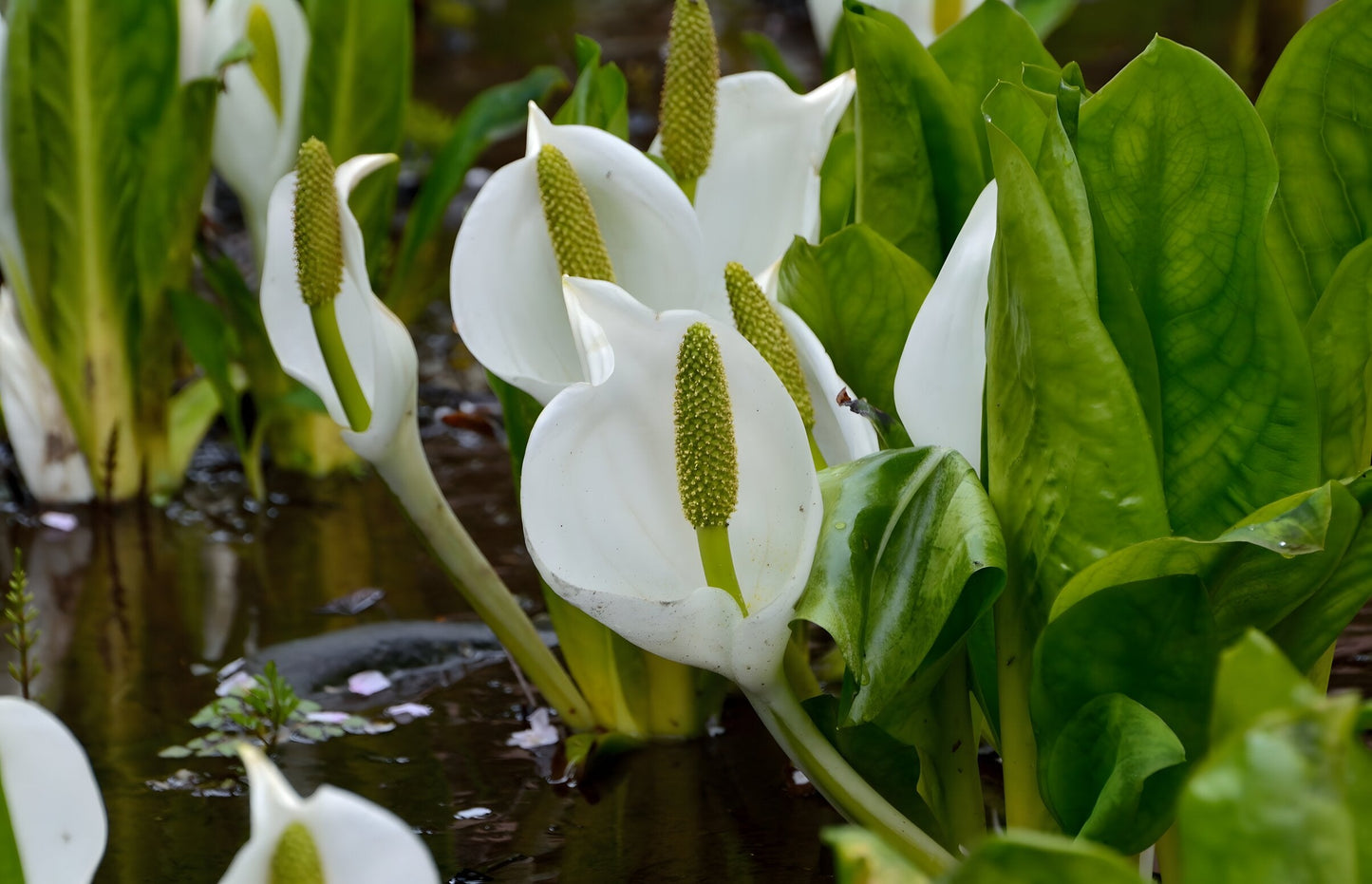
Lysichiton camtschatcensis - White Skunk Cabbage, Pond Marginal Plant
Lysichiton camtschatcensis - White Skunk Cabbage, Pond Marginal Plant
Couldn't load pickup availability
Lysichiton camtschatcensis, known as white skunk cabbage, holds the RHS Award of Garden Merit. In early spring, before the leaves, it carries fragrant, pure white spathes around a green spadix. Huge, glossy, oval leaves up to 90 cm long follow. This is the white-flowered Asian species, not the yellow American skunk cabbage, Lysichiton americanus, which is banned from sale in Great Britain.
White skunk cabbage at a glance
| Botanical name | Lysichiton camtschatcensis |
|---|---|
| Common name | White skunk cabbage, Asian skunk cabbage |
| Plant type | Clump-forming perennial; dies back in autumn |
| Height and spread | About 50 cm–1 m tall; leaves up to 90 cm long |
| Flowers | Pure white, fragrant spathe around a green spadix, March to May |
| Position | Full sun or part shade; sheltered |
| Soil | Permanently wet, fertile, humus-rich soil |
| Pond depth | At or just below the water line |
| Hardiness | RHS H7 – very hardy (below -20°C) |
| Native to | North-east Asia (not UK native) |
Is it legal to sell and grow?
Yes. Lysichiton camtschatcensis is not on any GB restricted list. The yellow L. americanus is a listed invasive species and cannot be sold, and the hybrid between the two (L. × hortensis) is also treated as not saleable. Our plant is the white-flowered L. camtschatcensis: true plants have pure white spathes, and yellow or cream spathes point to L. americanus or the hybrid. Do not plant it in the wild: it has naturalised in places, and in Scotland it is an offence to plant any non-native plant in the wild.
Where to plant white skunk cabbage
- Wet pond margins, at or just below the water line
- Bog gardens and stream banks with rich soil
- A sheltered, partly shaded spot
How to plant and care for it
Plant in spring or summer in permanently wet, humus-rich soil. It is slow to establish, so give it time and plenty of room for the leaves.
Is it poisonous?
Yes. The RHS says it is harmful if eaten, can irritate skin and eyes, and is harmful to pets. Wear gloves when handling it.
Which size should I buy?
Bare-root plants (7 cm, 9 cm, 1 litre and 3 litre) arrive without a pot or compost and are the most economical way to plant a group. Potted plants (9 cm, 1 litre and 3 litre) arrive growing in our peat-free compost and give a faster display. Packs of 3 come in 7 cm, 9 cm, 1 litre and 3 litre bare-root sizes and cost less per plant. The 2x Pot & Compost option is two plants supplied with pots and compost.
Share