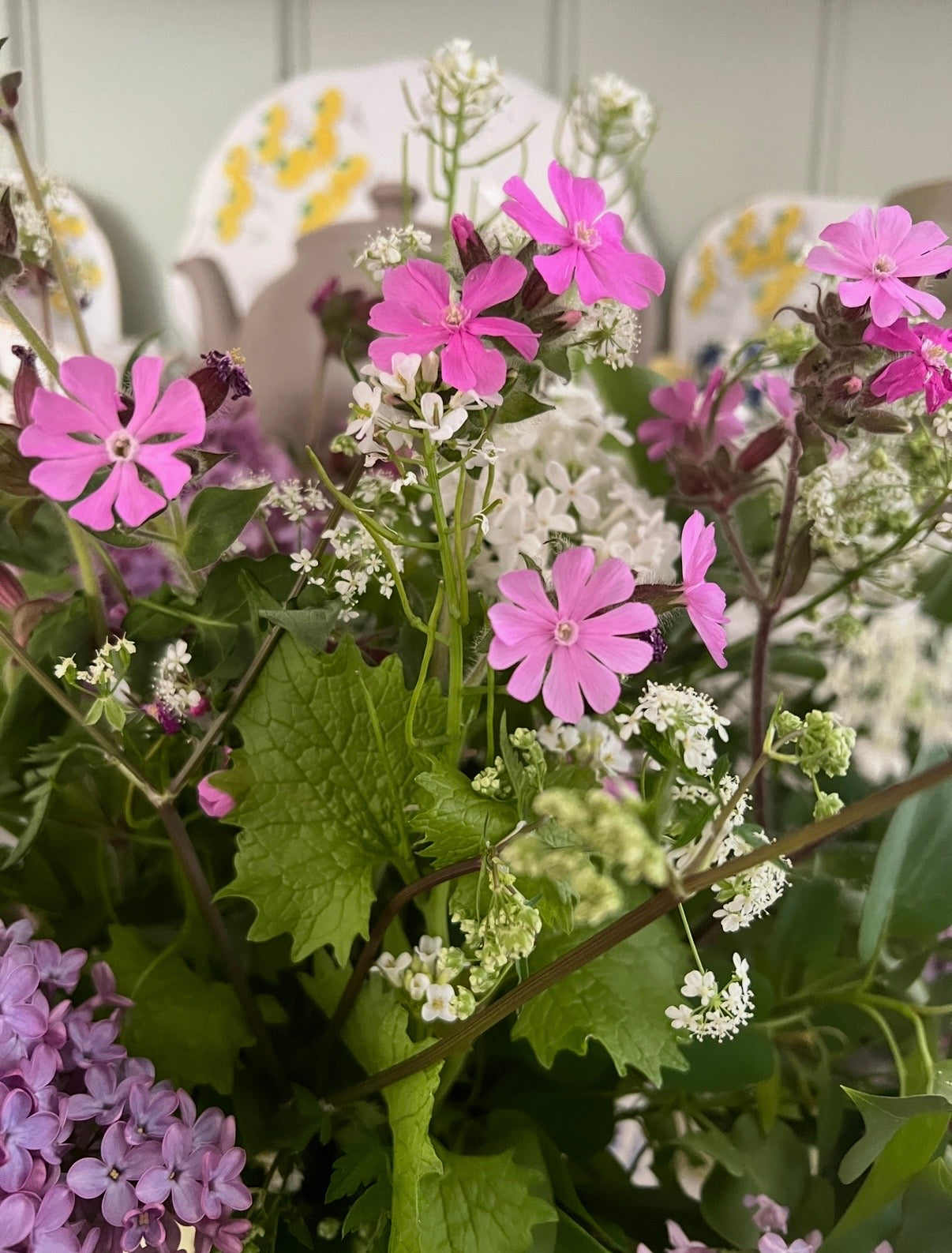
Red Campion
Red Campion
Couldn't load pickup availability
Silene dioica Red Campion / Pink Campion
Masses of vivid rose-pink five-petalled deeply-notched flowers on tall hairy stems above mid-green leaves — Red Campion is the native British shade wildflower of woodlands and hedgerows, the perennial that brightens shady corners with confident rose-pink colour from May through August, and one of the most ecologically valuable native plants you can grow for the British shaded garden.
This is one of the great native British wildflowers. Red Campion (despite its name, the colour is genuinely rose-pink rather than red — the "Red" refers to its position as the pink-end of the Campion family alongside White Campion) produces masses of bright rose-pink flowers from May through August, each one a precise five-petalled star with deeply-notched petal tips that give the flower a characteristic delicate cut quality. The plants grow tall (75–90cm) on hairy stems clothed in mid-green leaves, creating a substantial display when established. Hardy native perennial (H7, surviving below -20°C). Often behaves like a biennial in its first year — growing leaves in year one and flowering profusely in year two — but self-seeds reliably, ensuring a permanent colony in the garden indefinitely once established. RHS Plants for Pollinators — particularly valued by long-tongued bumblebees, butterflies, and the day-flying Yellow Shell moth.
A botanical curiosity: the species name dioica means "two houses" in Greek — referring to the fact that male and female flowers grow on separate plants (rather than both on the same plant as most flowering species). You need a mix of both male and female plants for seeds to set, which is why Red Campion is most reliably established by sowing generous quantities rather than just a few plants.
A note on growing
As a native wildflower, Red Campion is incredibly easy to grow and requires no special treatment. Direct sow outdoors in Autumn (Sept-Oct) or Spring (March-May). Scatter seeds on the surface of raked soil — do not cover heavily, just press them into the earth. Germination 14–21 days.
Red Campion prefers dappled shade or partial shade, mimicking its natural woodland habitat — though it tolerates full sun if soil moisture is reliable. Any reasonable garden soil suits it. Once established, it self-seeds reliably to maintain permanent informal colonies.
The colour contrast with White Campion: in the wild, Red Campion (Silene dioica) and White Campion (Silene latifolia) can cross-pollinate where their ranges overlap, producing intermediate pink-flowered hybrids. If you grow both colours in the garden, expect the same hybridisation over time — many gardeners welcome this as it creates a graduated colour palette from white through pink to red within a single self-seeding colony.
Where it shines
In woodland borders, dappled shade, and beneath deciduous trees and shrubs — Red Campion is one of the very few decorative perennials genuinely happy in light shade. As a native wildflower meadow component for shaded meadow edges. Along north-facing hedgerows in the cottage garden. As a self-seeding informal colony in any naturalistic planting. In wildlife gardens for the high native pollinator value. In cut-flower-from-the-cottage-garden for informal posies (the flowers cut well and last reasonable time in the vase).
Plant alongside
The classic British woodland-edge combination: combine Red Campion with Foxglove 'Excelsior Mix' (matching shade tolerance, taller vertical structure) and Bluebell (if stocked) for the iconic British woodland tapestry. For cottage shade, pair with Aquilegia 'Barlow Mixed' and Hesperis 'Purple' (Sweet Rocket) for layered shaded cottage colour. With Forget-me-not 'Blue' for spring carpet effect beneath the Red Campion stems.
Share